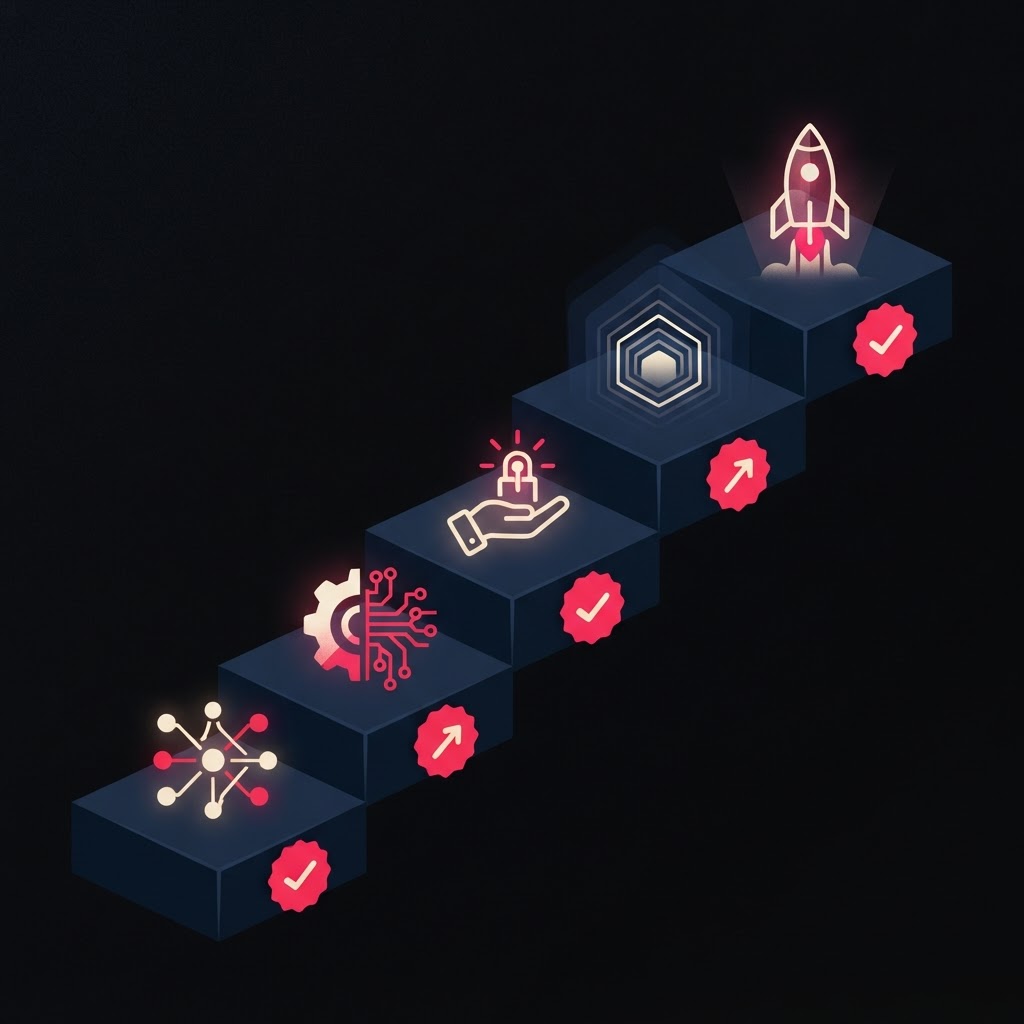
Search "how to learn AI roadmap" and you get the same thing on every page: months, hours and a course list for each stage. Watch this, then that, then this other thing. Ten months later you have a folder of certificates and nothing a stranger has ever used.
This roadmap works the other way round. Every stage ends with something you shipped, and you can't move on until someone other than you has used it. Same skills, different scoreboard.
The short answer
Pick a track first. Then go through five stages, and don't leave any of them until you've built the thing that proves you finished it.
That rule matters more than which course you pick. According to course.careers, skipping stages is the most common reason people spend 18 months "learning AI" and still can't build anything useful. The same guide says the people who get stuck are almost always the ones collecting certificates instead of building things.
So here is the roadmap, measured in output.
First, pick your track
Most roadmaps quietly assume you want to be a machine learning engineer. Most people don't. AI Weekly splits learners into three paths: AI user, AI builder and AI researcher. It puts strong AI literacy at two to four weeks of focused effort and the builder path at six to twelve months of study before you're competitive for development roles.
Track A: apply AI
You use AI, automate with it and build tools on top of it, inside a real job like marketing, operations, consulting or sales. You don't need Python for this. The GenAI Unplugged roadmap says that for 90% of non-technical professionals, Python isn't needed to get enormous value from AI, and that you need it only when you want to train custom models or do ML research. If this is you, we've mapped the whole path to learn AI without coding.
Track B: build models
You want to train, fine-tune and deploy models as an ML or AI engineer. That means Python, some math and a lot more hours. It's a real path and a good one. It just isn't the default, and you should pick it on purpose.
Not sure which? Start on Track A. Stages 1 to 3 are the same for everyone, and you'll know by Stage 4 whether you want to go deeper into code.
The roadmap, stage by stage
Each stage below has three parts: what you learn, roughly how long it takes, and the exit test. The exit test is always something shipped.
Stage 1: Fluency
Learn: one AI assistant, used daily on real tasks. How to give context, specify the output you want, show examples and iterate.
Time: Beginners in AI puts basic AI literacy at 5 to 10 hours and power-user skill at 30 to 50 hours over four to eight weeks.
Exit test: a piece of work someone else relied on that you made faster or better with AI. A research summary your team used, a client email that got a reply, a slide deck that got presented. "I practised prompts" doesn't count.
Stage 2: Automation
Learn: connect AI to a workflow, so it runs without you typing into a chat box. No-code automation tools and simple agents that call other tools.
Time: the same source puts AI automation capability at another 50 to 80 hours.
Exit test: one automation that runs on real inputs every week. It could take a form submission and draft a reply, or sort incoming leads and write a briefing. If you want a guided first build, follow how to build your first AI agent with no code.
Stage 3: A tool someone else uses
This is the stage every ranking roadmap skips, and it's the one that matters most.
Learn: scoping a small problem, building a tool for it, putting it in front of a user and fixing what breaks. This is where you go from AI user to AI builder.
Time: a few weeks per tool. Ship small, ship often.
Exit test: a named person, not you, used your tool more than once without you standing next to them. Need ideas? Start with these AI project ideas for beginners.
Stage 4: Depth in one direction
Now you branch.
Track A: go deep in one domain, like AI for marketing, operations or sales, and chain your Stage 2 and 3 skills into systems that run a whole process.
Track B: this is where the classic technical roadmap starts: Python, machine learning, deep learning, LLMs, deployment. Futurense lays this out in six phases and says most beginners reach a job-ready foundation in six to nine months at eight to ten hours a week. Its portfolio advice fits our rule exactly: at least one project that is actually deployed and reachable through a link, not just code on GitHub.
Exit test (both tracks): a portfolio of three shipped things with a short write-up of the problem, what you built and what happened. Here's how to build a portfolio with no experience.
Stage 5: Real stakes
Side projects teach you to build. Real ventures teach you to build when it matters: deadlines, users who complain, budgets, a team depending on your output.
That's the model we run at EX EPIC Academy (formerly EX Venture Academy). We skip the case studies. Students from 26 nations work on 15 live projects, with no grades and no exams. Participants are placed in operational roles at real ventures, including Gemino AI in automation, Zero X in waste-to-energy and LIV Urban Sanctuary in wellness.
Exit test: you can point to a result in a real organisation and say "I shipped that." That sentence beats any certificate in an interview.
How long the AI roadmap really takes
Every figure below comes from the ranking roadmaps themselves. Treat them as ranges, not promises.
| Goal | Time it takes | Source |
|---|---|---|
| Basic AI literacy | 5 to 10 hours | Beginners in AI |
| Power user | 30 to 50 hours | Beginners in AI |
| Automation capability | another 50 to 80 hours | Beginners in AI |
| ML engineering fundamentals | 300 to 500 hours | Beginners in AI |
| Full 12 month technical plan | 388 to 512 hours | AI Weekly |
| Job-ready technical, 8 to 10 h/week | 6 to 9 months | Futurense |
| Job-ready technical from zero, part-time | 18 to 24 months | course.careers |
What the table shows: add up the first three rows and Track A through Stage 2 comes to roughly 85 to 140 hours. That's a semester of evenings, not a degree. Track B is a real multi-month commitment, and the honest part-time number is closer to two years than to the "AI in 30 days" promises.
Where most roadmaps fail you
They reward watching. GenAI Unplugged calls it tutorial hell: passive consumption without building equals zero progress. A roadmap measured in courses finished encourages exactly that.
They put building last. The standard technical plans leave the portfolio for the final months, so for most of a year you have nothing to show anyone. Flip it. AnyCap describes the loop that works: build something, hit a wall, learn the concept, build again.
They ignore momentum. course.careers says the biggest risk on a part-time roadmap isn't pace, it's losing momentum, and recommends a weekly non-negotiable minimum instead of a daily goal. Put a shipping date on every stage and you get that minimum without trying.
The roadmap is simple. Pick a track, ship at every stage, and let each shipped thing tell you what to learn next. If you're starting from zero and want even smaller steps, a step by step guide for total beginners is on the way.
FAQ
Do I need math before I start learning AI?
Not for Track A. You can use, automate and build with AI without formal math. For Track B you'll need linear algebra, calculus and statistics eventually, and many people learn them alongside building rather than before it.
Is a certificate enough to prove I learned AI?
No. A certificate proves you finished a course. Employers want to see what you can do, and people who collect certificates instead of building are the ones who stall. Show a shipped project and what happened when people used it.
Can I follow an AI roadmap part-time while studying or working?
Yes, and most people do. Set a weekly minimum you never skip, and give every stage a shipping date. Expect Track A to take a few months of evenings and Track B from zero to take well over a year part-time.
Which AI roadmap should a non-technical person follow?
Track A. Most non-technical professionals don't need Python to get real value from AI. Take Stages 1 to 3, ship a tool someone uses, and only move into code if Stage 4 pulls you there.