Every job wants experience. Nobody will give you the first one. So you search for how to build a portfolio with no experience and you get the same six bullet points on ten different sites, all of which assume you already have something to put in it. Here is the part they skip: no experience does not mean no ability. It means no proof. And proof is the one thing on that list you can manufacture yourself, starting this week, without anyone's permission.
The short answer
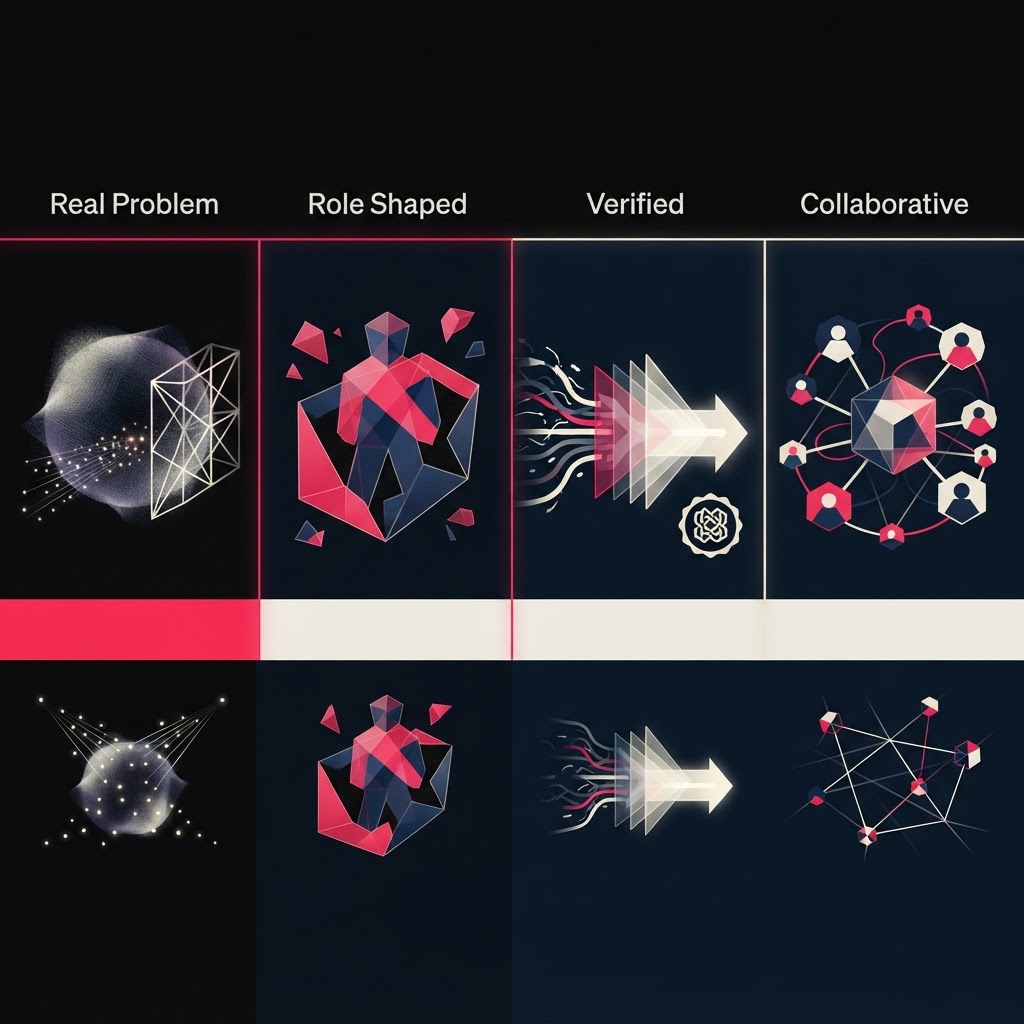
Build three or four finished pieces that a stranger can inspect in five minutes: one real problem solved for a real person, one piece shaped like the job you actually want, one piece somebody other than you can verify, and one piece you did not build alone. Write each up as problem, action, result, proof. That is a portfolio. Everything below is how to source the work and how to write it so a reviewer believes it.
Employers are already hiring on proof, not on your job history
This is not motivational framing, it is what the buyer side reports. In NACE's Job Outlook 2026 Spring Update, surveyed across 185 employers in February and March 2026, nearly 70% now say they use skills-based hiring, and employers named the top way to demonstrate skills as sharing concrete examples of situations where you used them to solve problems. Same report: hiring for the Class of 2026 is projected up 5.6%, a plurality of 45% of employers call the market only fair, 13.3% of jobs and 10.5% of entry-level postings now require AI skills, and demand for those skills has almost tripled since the previous autumn.
Read those together and the strategy writes itself. The market is competitive but not closed. The gate is a specific example, not a credential. And the fastest-growing requirement, AI skills, is one nobody can claim seniority in yet, which is why AI is thinning the entry level for routine work while opening it for anyone who can show a built thing.
No experience means no proof, not no ability
Frame the problem correctly and it shrinks. As one hiring guide puts it, no experience does not mean no evidence, and you do not need a large portfolio, you need a convincing one. Evidence can come from projects, volunteer work, coursework you took further than the assignment, or a contribution to something other people use.
This matters most when your CV has nothing else doing the work. A guide written for Indian freshers makes the point sharply: a portfolio is the great equaliser when your college tag does not open doors on its own, because a transcript answers whether you passed your exams and a recruiter is asking whether you can do real work on Monday. The same guide names the mistake almost every beginner makes: the unverifiable claim. A screenshot, a self-issued course certificate, a trust-me-I-built-this repository. Anyone can produce those, so a careful reviewer discounts them to roughly zero.
So the target is not more work. It is fewer pieces, each of which is checkable.
The four pieces a portfolio with no experience needs
1. One real problem, solved for a real person
Pick something that actually annoys someone. Realness is what makes it credible, and self-initiated work counts as experience because it demonstrates initiative, which employers value enormously in juniors. Good candidates: a signup or attendance tool your college club keeps handling in a group chat, a dashboard for a friend's small business, a script that kills a tedious weekly task, a redesign of an app you use and dislike.
The bar is not sophistication. It is that a named human had the problem before you built the thing and does not have it afterwards.
2. One piece shaped like the job you want
Each piece should answer a specific doubt a hiring manager has about you. If the role handles messy data, ship something that ingests messy data. If it writes landing pages, write a landing page, an email sequence and three posts. If it builds automations, build an automation that runs on a schedule without you. The test is whether the output looks like a junior's first week at that job rather than a course assignment. Stuck for a starting point? AI project ideas for beginners is a longer list of things you can finish in a weekend.
3. One piece somebody else can verify
This is the one almost everyone skips, and it does the heaviest lifting. Verification means an outside signal a reviewer can check without trusting you: a merged pull request in a public repository, a live URL with real users, a graded credential tied to a specific piece of work, a testimonial from the person you did the work for with their name and role on it. One verified piece changes how the other three read.
4. One piece you did not build alone
Almost all real work is collaborative, and a solo portfolio quietly raises the question of whether you can work with people. A hackathon build, an open-source contribution, or a project paired with a friend where each of you owns a documented part all clear this. Say explicitly which parts were yours.
Four pieces is the ceiling, not the floor to build past. Two or three excellent projects that demonstrate real problem-solving will outperform a dozen tutorial clones, and depth is what gets asked about in the interview.
Where to get real work when nobody will hire you
Five routes, in the order most people should try them.
Your own annoyance. Fastest, zero permission needed, and it doubles as the story you tell about why you built it.
A small business or a nonprofit. One or two capped projects give you a real outcome and a testimonial. Two conditions: fix the scope in writing so it does not turn into indefinite free labour, and get permission to show the work before you start. Work you are not allowed to publish is not portfolio work.
A club, society or student org. They have real users, real deadlines and nobody maintaining anything. This is the easiest place on earth to find a live problem.
Open source. A merged pull request is proof with a public timestamp, and it doubles as your collaboration piece. Start with documentation and small bug fixes in a project you actually use.
A hackathon. Forty-eight hours produces a finished, demoed, team-built artefact, which is three requirements in one weekend.
What all five have in common is a real person on the other end. That is also the honest case for the right kind of internship: a startup internship hands you real responsibility instead of a slide deck nobody reads, which is the difference between four months of experience and four months on your CV. If you are running the wider job hunt at the same time, how to get a job with no experience or degree covers the rest of the funnel.
How to write up a project so a reviewer believes it
A great project described badly persuades no one. Recruiters skim, so use the same four lines for every piece: the brief in one line, what you did, the result with a number in it, and a link to the proof so the reader can confirm it independently.
Weak entry:
Attendance App. Built an attendance app using React and Firebase. Learned a lot about databases and state management.
Strong entry:
Attendance tracker for a 60 member university robotics club. They tracked attendance in a WhatsApp thread and lost eligibility records twice a term. I built a signup and check-in tool, ran it for one term, and cut roll-call from 10 minutes a session to under 1. Used by all 60 members and still running. Live link, repository and a note from the club president.
Same project. The second one names a person, a problem, a number and a way to check. Add one outcome line to every piece, and document how you thought, not only what you produced, because juniors are hired on how they think. What you tried first and why you abandoned it is often the most persuasive paragraph on the page.
What kills a beginner portfolio
The tutorial clone. Everyone has the same weather app and sentiment classifier. If you include one, extend it hard: new features, real deployment, the edge cases the tutorial ignored.
Quantity as a substitute for quality. Twelve half-finished repositories read as twelve abandonments.
Missing context. A screenshot with no problem statement makes the reviewer do the work of understanding you, and they will not.
A story that contradicts itself. Your resume, LinkedIn and portfolio should carry the same headline and the same top projects at different depths. A resume that says one role and a portfolio that says another creates confusion, and confusion loses interviews.
The unverifiable claim. Covered above, and worth repeating because it is the failure that quietly voids everything else.
Your 30 day portfolio, week by week
- Week 1. Choose and scope. Pick one target role and write down the three doubts a hiring manager would have about you. Find one real problem belonging to a real person and agree the scope with them.
- Week 2. Ship piece one. Finish it end to end, however ugly. Put it in front of the person who had the problem, then write it up in the four-line structure the same day, while you still remember what you tried.
- Week 3. Ship the role-shaped piece and start the verification. Open the pull request, ask for the testimonial, get the live link in front of users. Verification has lead time, which is why it starts now and not in week 4.
- Week 4. Package and publish. One page a reviewer can open: target role at the top, three or four pieces, contact details. Then mirror that exact positioning into your resume and LinkedIn headline.
Four pieces, thirty days, from nothing. Notice what is not on this list: another course. You already know enough to build something small and badly. That is the entry requirement.
Why a deadline beats motivation
Here is what we see running an academy full of people doing exactly this. The ones who build a portfolio fastest are almost never the most talented. They are the ones with someone waiting on the output by Friday.
We run EX EPIC Academy out of Canggu, Bali, on a deliberately blunt premise: no grades, no exams, real ventures and real stakes. That currently means participants from 26 nations working on 15 live projects, placed into operational roles inside real companies in the group, from waste-to-energy engineering at Zero X to automation at Gemino AI to wellness at LIV Urban Sanctuary. Four to six months on site, across 78 open positions spanning AI, engineering, consulting, marketing, sales and research.
What that structure actually removes is the escape hatch. When a live venture needs the tool by Friday, nobody rewatches a tutorial. People leave with a portfolio because leaving without one was never an option, and the same participants tend to go from AI user to AI builder in the process.
If you cannot get into an environment like that, build the pressure yourself. Promise one real person one specific deliverable by one specific date, out loud, in writing. The embarrassment of missing it will do what motivation was never going to.
FAQ
How many projects should a portfolio have if I have no experience? Three or four finished, documented pieces. Two or three genuinely good projects beat a dozen tutorial clones, because interviewers dig into one project rather than counting them. A portfolio needs to be convincing, not large.
Do concept or fake client projects count in a portfolio? Yes, if you label them honestly as concept pieces. Designers, writers and marketers routinely complete realistic industry briefs and present them as case studies. They sit one rung below work with a real user attached, so use them to fill gaps rather than as the whole portfolio.
Can I put unpaid or volunteer work in my portfolio? Yes, and it is one of the fastest routes to a real outcome plus a testimonial. Cap the scope in writing so it cannot drift into indefinite free labour, and confirm you may publish the work before you begin.
Do I need a website for my portfolio? No. A personal site, a Notion page, a well organised PDF or a tidy GitHub profile all work, as long as a reviewer can open it in one click and find your target role and best pieces immediately. The container is not what gets you hired.
How long does it take to build a portfolio from nothing? Roughly four focused weeks for three or four credible pieces, one per week plus a packaging week. The bottleneck is shipping and writing up, not learning more, which is why people who keep studying stay at zero pieces for months.