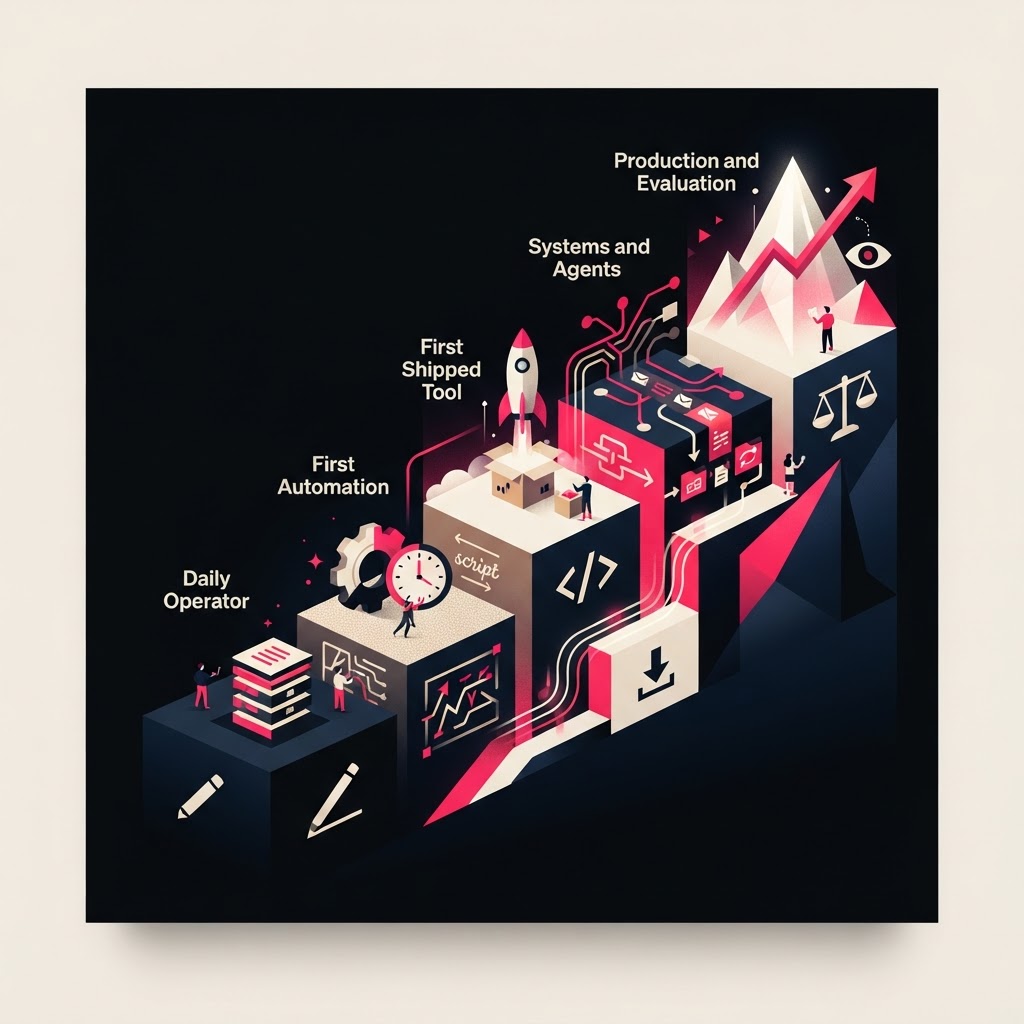
You already use AI every day. You draft with it, you argue with it, you paste your code into it at 2am. And yet nothing you have made with it exists outside the chat window. That is the whole problem, and it is why so many people search for how to go from AI user to AI builder without finding an answer that survives contact with a Tuesday. Most guides either tell you to "just start building" or sell you a six month roadmap to become an AI engineer. Neither describes the actual ladder. This one does: five rungs, one artefact per rung, and the receipts on why the climb is worth more now than it will ever be again. ## The short answer You stop being an AI user the moment you produce something that runs without you sitting in the chat window. Not a better prompt. Not a saved thread. A thing: a script, an automation, a bot, a small tool that another human can use while you sleep. Everything below is the ladder that gets you there and the order to climb it in. ## The gap is real, and 2026 surveys show exactly how wide ### Almost everyone is a user now Using AI has become unremarkable. Gallup's Q2 2026 measurement found that 52% of US workers now use AI in their role, with 30% using it a few times a week or more and 15% using it daily. SurveyMonkey's Q1 2026 study of 8,482 US adults puts 34% of full-time workers on daily or weekly AI use at work, and it found something more useful for you: those users are 75% self-taught, 19% trained by their employer, and just 9% learned any of it in formal education. Nobody is teaching this. The ladder is self-serve, which is exactly why it stays climbable. ### Almost nobody is a builder Now look at the other end. SHRM surveyed 5,875 US workers in March and April 2026 and found 41% using AI for work. In the same study, only 6% of organisations had built AI into their own enterprise software and only 4% had internally developed an AI tool at all. Read that twice. Roughly half the workforce is prompting. Roughly one company in twenty-five has made anything. The shortage runs all the way up. Deloitte's State of AI survey found workforce access to sanctioned AI tools grew from under 40% to around 60% in a single year, yet only 25% of organisations had moved 40% or more of their AI experiments into production. Experiments are cheap. Shipped things are rare. That scarcity is not a threat to you, it is the arbitrage. While AI is thinning the entry level for people who can only do routine work, the market is starving for anyone who can take an idea and make it run. ## What actually separates a user from a builder It is not talent and it is not a degree. It is four specific shifts, and they happen in roughly this order. From prompting to managing. A user thinks in individual prompts. A builder thinks in systems: context files, constraint rules, memory across sessions, directing the model the way you would direct a capable but very literal colleague. The same shift shows up as tool-hopping to tool-knowing and one-off builds to compounding systems, where your tenth build connects to your first instead of standing alone. From tools to problems. Users ask "which AI tool is best?" Builders ask "what is broken, and what removes it?" The distinction has a name: the coder mindset starts with the technology, the builder mindset starts with the problem and then goes looking for whatever already exists to solve it. You do not need to understand a language model at the mathematical level. You need a working map of what it can do. From consuming to shipping. This is the brutal one. Watching someone present about AI and watching someone build with it are different activities, and only one of them changes you. One founder who spent fifteen years around engineers without writing code shipped six working agents in five weeks once he stopped learning about AI and started learning with it: a daily briefing agent in six hours, a meal planner in four, a content engine in twelve. From tourist to specialist. Here is where we part company with most advice. Plenty of roadmaps define "builder" as AI engineer and quote you six to twelve months to job-ready with Python, linear algebra and model training. That path is real, and almost nobody needs it. You are not going to train a model. You are going to wrap models other people spent billions training around a problem you understand better than they do. Your domain knowledge is the scarce input, not the maths. ## The five rung ladder from AI user to AI builder Each rung has one artefact that proves you left it. If you cannot point at the artefact, you are still on the rung below, no matter how many videos you watched. ### Rung 1: Daily operator You use one strong model on real work, every day, and you can tell when it is confidently wrong. Depth over variety: one tool used daily beats twenty bookmarked. Realistically this takes two to four weeks of daily practice with no coding at all. Artefact: a task you used to do manually every week that you now do with AI, faster, at the same quality. If you want the full map of what belongs at this level, see which AI skills actually get you hired. ### Rung 2: First automation You stop copying output between windows and make something run itself. A scheduled script, an n8n or Zapier flow, a spreadsheet that fills itself. The rule that keeps this honest: if a script saves you an hour a week, that script is the product. No app required. Artefact: something that ran while you were not watching, at least twice. ### Rung 3: First shipped tool This is the rung where the identity flips, and it is smaller than it looks. A non-coding product manager mapped the entire climb into one day: two hours on environment and a free course, three to four hours building, one to two hours polishing and pushing to GitHub. His own first build was a Chrome extension that pulled job postings into a spreadsheet, born out of pure annoyance. You do not need Python for this. Claude Code, Lovable, Replit and n8n have removed the language prerequisite for everything short of training your own models. If you want the walkthrough rather than the map, start with build your first AI agent with no code. Artefact: a tool one other person used without you narrating it. ### Rung 4: Systems and agents Your builds start talking to each other. Research feeds content, content feeds distribution, distribution feeds the next iteration. You are no longer producing tools, you are producing leverage, and each new build costs less than the last because the plumbing already exists. Artefact: two builds where one consumes the other's output. ### Rung 5: Production and evaluation The professional gate, and the one almost everyone skips. The credible exit criterion is one AI feature shipped to production plus an evaluation suite of at least 20 documented test cases, and the ability to explain where the model fails and what guard rails you added. Not a demo that works in isolation. Something running against real inputs. That is also where the unglamorous engineering lives: containerisation, cloud infrastructure, CI/CD, security and observability are the real distance between a prototype and a product. Artefact: a live thing with a documented failure mode. Be honest about where you need to land. Most careers are transformed by rungs 1 to 3. Rungs 4 and 5 are for people building AI as the job, not with it. ## What to build first Pick something that annoys you. That is the entire selection criterion. Good first projects: a scraper that dumps a website into a spreadsheet, a bot that answers your team's five repeated questions, a browser extension that kills one click-heavy routine, a dashboard over data you already keep in a spreadsheet, a report generator that fills your weekly template. Bad first projects: "something like ChatGPT but better", "an app for 100,000 users", and anything without a specific pain behind it. Ugly is fine. Working is mandatory. Version one of a paid macOS product shipped with a basic interface and rough edges because it solved the core problem, and that was enough for people to pay. If you are hunting for a starting point, AI project ideas for beginners has a longer list, and where to start learning AI covers the groundwork if rung 1 still feels shaky. ## Where people stall, and how to get unstuck Five stalls account for almost everyone, and each one feels like progress from the inside: 1. Tutorial completion without deployment. Finishing a course feels like capability. Fix: commit to shipping one thing to a real audience before starting the next course. 2. Switching tracks before the gate. The discomfort of depth gets misread as a signal to change direction. 3. Building only in notebooks. Production friction stays invisible until it is a deadline problem. 4. Consuming AI news instead of using AI. The aware-but-not-competent zone feels like preparation. 5. Waiting for the right foundation. Prerequisite anxiety is procrastination with better branding. The gap is almost always smaller than the fear of it. Two more are worth naming. The forty-bookmarks pattern: a new tool every week, a free tier hit every week, no system after six months. And the one-bad-answer wall: you get one hallucinated response, conclude AI does not work for your field, and quit. Catching a bad output and redirecting it is the skill, not a sign the tool is broken. And the timing trap nobody warns you about: the first step is not the hardest. Opening the tool alone the next morning is. ## Why environment beats willpower Here is what we see running an academy full of people making exactly this climb. The ones who move fastest are almost never the most technical. They are the ones with a deadline and someone waiting on the output. We run EX EPIC Academy out of Canggu, Bali, on a simple premise: no grades, no exams, real ventures and real stakes. Right now that means participants from 26 nations working on 15 live projects, placed into operational roles inside real companies in the group, from waste-to-energy engineering at Zero X to automation at Gemino AI to wellness at LIV Urban Sanctuary. Four to six months on site, across 78 open positions spanning AI, engineering, consulting, sales and research. What that structure actually does is remove the escape hatch. Rung 3 stops being optional when a real venture is waiting on the tool by Friday. We watch people jump two rungs in a month for that reason alone, not because they suddenly got smarter. If you cannot buy that environment, manufacture it: promise someone a working thing by a date, out loud, and let the embarrassment do the work motivation was never going to do. ## Your first 30 days - Week 1. Pick one model and use it on real work daily. End the week with one weekly task you now do faster. That is rung 1.
- Week 2. Take that same task and make it run itself. Scheduled script, automation flow, whatever fits. Something has to execute without you present. That is rung 2.
- Week 3. Build the ugliest working version of one tool that solves one annoyance. Ship it to a GitHub repository the same week. That is rung 3, and it is the whole game.
- Week 4. Give it to one real person, watch them use it without explaining anything, and rebuild based on what you saw. Then write down where it fails. Four artefacts in thirty days. Remember the SHRM number at the top: only one organisation in twenty-five has internally developed an AI tool. You will not be ahead because you outworked anyone. You will be ahead because almost nobody makes the thing. ## FAQ Do I need to learn Python to become an AI builder? Not to start. Modern no-code and AI-coding tools cover rungs 1 through 3 entirely, and you can describe what you want in plain English. Python becomes non-negotiable only if you intend to train or fine-tune models yourself, which most builders never do. How long does it take to go from AI user to AI builder? Two to four weeks of daily practice to be a confident power user with no coding, one focused day for a first working tool, and roughly six to twelve months at ten hours a week if the goal is job-ready AI engineering. Pick the destination before you pick the timeline. What is the difference between an AI power user and an AI builder? A power user applies AI tools inside their existing job. A builder makes AI part of a product or system that runs for other people. The daily work and the exit criteria are completely different, which is why targeting the wrong one wastes months. Is an AI certificate worth it for getting hired as a builder? Course completions are not the gate; evaluated, reviewable output is. Take a course in parallel with a real project so the material sticks, never as a prerequisite you finish before you are allowed to start. What counts as proof that I am an AI builder? Something running against real inputs for a real user, plus the ability to say where it breaks. A documented failure mode beats a polished demo, because anyone reviewing you will ask the second question, not the first.