Search "which jobs are safe from AI" and you get lists. Firefighter. Surgeon. Airline pilot. Tree faller. All of them true, and almost none of them useful if you are 23 with a business degree and eleven months of job applications behind you. We train young builders inside real ventures for a living, so here is the answer we actually give them.
Safe is not a job title. Safe is a task profile. Two people with the same title on the same floor can sit on opposite sides of the exposure line, because what gets automated is tasks, and job titles are just bundles of tasks that happen to be sold together. Once you see it that way, the question stops being "which list am I on" and becomes "how many protective properties does my work have, and can I add more".
This article gives you the four properties the underlying research actually measures, a five-minute test to score your own role, and the part nobody publishes: what to do when your job scores badly. Fair warning up front, from the people who build these rankings: no job is 100% AI-proof. Resistance is a spectrum, not a badge.
What the data actually says makes a job safe
Forget the lists for a minute and look at what the exposure datasets have in common.
The structural factors: a body, a bond, and an economic case
The cleanest framework comes from a scoring model applied across 33 countries and 2.9 billion workers using ILO employment data. Three factors, when present together, reliably produce low AI exposure.
First, physical presence in unpredictable environments. Current AI is software. It cannot wire a house, harvest a crop in the rain or reposition a person with limited mobility. Building trades score 2.0 out of 10 on exposure. Second, human interaction that requires emotional presence, which is why personal care workers score 2.0 out of 10, the lowest in that entire dataset, while general and keyboard clerks score 9.0 and customer service clerks 8.5. Third, the economics of automation: agricultural workers score 3.0 partly because deploying robotics across small, variable plots at low wage levels does not pay yet.
Note the asymmetry in that third one. It is real protection, and it is the fragile kind, because it erodes as hardware gets cheaper. The first two do not.
The occupations at the bottom of the exposure tables
Microsoft Research measured this from the other end, not by predicting what AI could do but by looking at what people actually used it for: 200,000 anonymized Copilot conversations mapped onto O*NET work activities and 785 occupations covering 149.8 million US workers. The occupations with the lowest AI applicability were nursing assistants, massage therapists, phlebotomists, water treatment plant operators, roofers and dishwashers. The highest were interpreters and translators, writers, editors, sales representatives, customer service representatives and computer occupations.
Read that top group again if you are a student. Sales, computer and mathematical, and office and administrative support are the three major groups scoring highest, and they are exactly where most graduate hiring happens.
The caveat the researchers put on their own numbers
Here is the part that gets stripped out of every listicle that cites this study. The authors published a follow-up specifically to say that their work draws no conclusions about jobs being eliminated, and they cautioned against reading it that way. A job is more than the sum of its listed tasks. High applicability means AI is useful in that occupation, which can mean displacement, and can equally mean the person doing it gets faster and more valuable.
So treat exposure scores as a weather forecast, not a verdict. They tell you which direction the wind is blowing on your tasks. What you build in that wind is still yours.
Why the popular safe-jobs lists do not answer your question
Now the lists, and why they leave you stuck.
The most-cited 2026 ranking analysed O*NET data on six abilities: stamina, static strength, reaction time, spatial orientation, time sharing and problem sensitivity. Its top ten came out as firefighters at a $59,280 median wage, airline pilots at $232,140, manufactured building installers, tree trimmers, structural iron and steel workers, derrick operators, roof bolters, commercial pilots, fishing and hunting workers and tree fallers. A different index from the same firm, filtered to high-paying roles and scored on adaptability, stress tolerance and self-control, produced a completely different top five: nurse anesthetists at an index of 93.3 and $195,263, emergency physicians, judges, general surgeons and commercial pilots.
Two studies, one firm, barely any overlap. That is not a scandal, it is a clue: each list is measuring one slice of protection. And both slices converge on the same two entry gates. Either a decade of licensing, or a body in a dangerous place.
That is why these pages feel unsatisfying. They answer "which titles are safest", when the reader is asking "what do I do on Monday". Meanwhile 52% of workers say they worry about AI's impact on the workplace and 32% expect fewer job opportunities for themselves long term. Anxiety at that scale deserves a method, not a leaderboard.
One more thing the lists rarely say out loud: jobs that look safe are often not. Paralegals and entry-level coders sit in categories most people assume are protected by expertise, and both are more exposed than assumed.
The four properties that actually protect a job
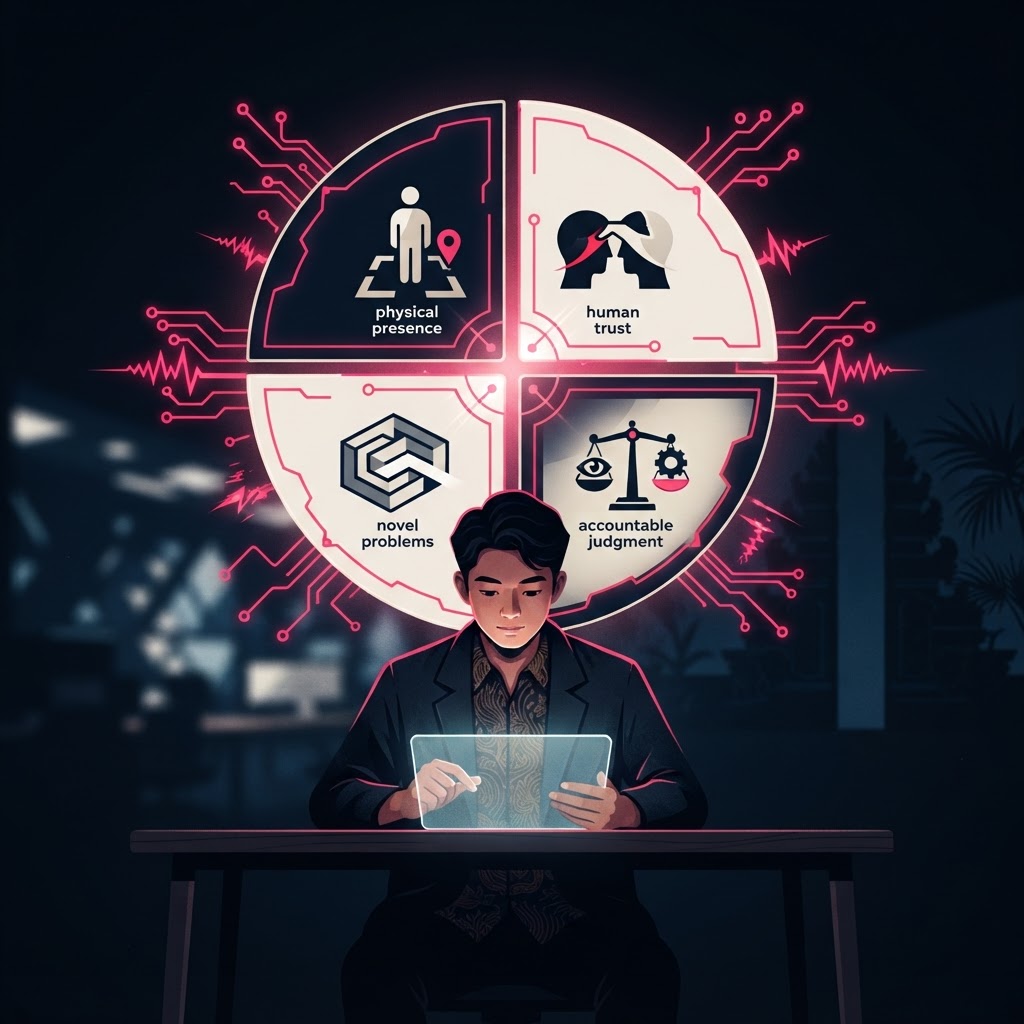
Strip every credible dataset down and the same four properties keep doing the work. This is the part you can apply to a job that appears on no list at all.
Physical presence in an unpredictable environment. Not physical labour as such, but a body needed in a place where conditions change. This is the single strongest protection currently available, and also the one with the highest entry cost in wear on you.
Human trust that a person has to carry. People do not want a model handling their grief, their kid's education or their mental health crisis. Trust is not a soft skill here, it is the deliverable.
Accountable judgment when the call is expensive. The career expert behind that top-ten ranking makes the point that those roles are not protected by physical labour alone: workers have to recognise problems, interpret changing conditions and make decisions in real time, and answer for how it turns out. Someone has to be liable. A model cannot be.
Novel problems that do not repeat. Rule-following work is what breaks first. Where every case is genuinely different, pattern-matching runs out of pattern.
Four properties. Most protected jobs hold three or four. Most entry-level jobs hold zero or one, and that is the real finding buried under all the listicles.
Score your own job in five minutes
Answer honestly. One point each.
- Does your work require you to be physically present somewhere conditions change?
- Does your value depend on a relationship or trust that a person must carry?
- Do you own outcomes in ambiguous situations, or do you mostly execute defined tasks?
- Is every case different, or is most of your work a repeatable pattern?
- Bonus penalty: are you early career in a role built on following defined rules?
Scoring: 0 to 1 properties means exposed. 2 means mixed, and the direction you push matters more than the score. 3 or more means durable for now.
Question five is the one that stings, and it should. Junior positions are being cut first and the climb-from-the-bottom ladder is genuinely breaking: Klarna says AI does the work of 700 customer service workers, and Salesforce cut support headcount from 9,000 to 5,000 with agentic AI. Honesty cuts both ways, though. Johns Hopkins researchers noted in that same analysis that cause and effect are not clean, because macroeconomic pressure and post-pandemic overhiring drive cuts that get labelled AI. We covered that whole argument, with the payroll data, in will AI replace entry level jobs.
If you scored 0 or 1, you are not doomed. You are where almost every 22-year-old is. The next section is the whole point of this article.
What to do if your job is not on any safe list
You have two options. Buy protection through a licence and years of training, or build the properties into the work you can actually get. Most people reading this should do the second, and it is more available than it sounds.
Pick the skills the market is repricing upward
Employers expect 39% of workers' core skills to change by 2030, down from 44% in 2023, so the churn is high but stabilising. In the same research, analytical thinking is the top core skill, essential for seven in ten employers, AI and big data are the fastest-growing skills, and resilience, flexibility and agility is the single biggest differentiator between growing and declining roles. Manual dexterity, endurance and precision go the other way, with 24% of employers expecting them to matter less.
Sit with that last number next to the trades data. Physical work is genuinely the least exposed to today's AI and simultaneously the skill category employers expect to demand less of. Both are true. Protection from one technology is not the same as a growing market.
If you are starting from zero, what AI skills actually means breaks down the stack, and go from AI user to AI builder is the step most people skip.
Get inside decisions, not just tasks
Properties three and four are the ones you can add without changing career. Volunteer for the ambiguous work. Ask to own an outcome rather than a deliverable. Take the client conversation nobody wants. Every one of those moves buys you a property that no exposure score can take back, and it compounds, because judgment is built from consequences you actually felt.
 Judgment grows where the decisions are real.
This is the mechanism we built EX EPIC Academy around. Participants spend 4 to 6 months on-site in Canggu in operational roles, inside live ventures: Zero X in waste-to-energy, Gemino AI in automation, LIV Urban Sanctuary in wellness. The cohort is students from 26 nations on 15 live projects. No grades. No exams. Real ventures, real stakes, inside a group with a 160M+ EUR capital track record and 200+ energy systems financed across 11 countries. We run it that way for one reason: you cannot be taught accountable judgment in a case study, because nothing is at stake in a case study. Whether you get that with us or somewhere else, apply the same filter to every role you are offered.
Make the proof visible
A property nobody can see does you no good in a hiring process. Ship things with your name on them, link them, show the outcome. Our method is in build a portfolio with no experience, and the longer skill map is in how to future-proof your career.
So: which jobs are safe from AI? The ones where a human body, a human bond, an accountable call or a genuinely new problem sits at the centre of the work. That is a description, not a list, and descriptions are portable. You do not have to find a safe job. You have to become the part of the job that is hard to replace.
FAQ
What job is 100% safe from AI?
None, and the analysts who publish the safe-lists say so themselves. Resistance is a spectrum, not a category. The closest thing to safety is an occupation holding three or four protective properties at once, which is why hands-on care, skilled trades and emergency work sit at the bottom of every exposure dataset measured so far.
Which jobs are safe from AI without a degree?
Skilled trades and hands-on care score lowest on AI exposure and are reachable through apprenticeship or certification rather than graduate school. Weigh that against the employer signal that manual dexterity, endurance and precision are declining in demand: low AI exposure and rising demand are two different things, and you want a route that has both.
Are tech and software jobs still safe from AI?
Computer occupations sit near the top of the AI applicability tables, not the bottom, alongside sales and administrative support. That does not make tech a dead end. It means junior implementation work is exposed while architecture, systems judgment and owning what ships are not, so the safety question inside tech is about which layer you work at, not whether you code.
Should I switch careers to something AI-proof?
Usually not on those grounds alone. Switching to chase a title on a list means paying for protection with years of licensing or physical risk, when two of the four protective properties can be built where you already are. Switching makes sense when you actually want the work, or when your current role holds zero properties and offers no path to add one.
How long will these jobs stay safe from AI?
Depends which protection they run on. The economics-of-automation protection is temporary and erodes as hardware costs fall. Physical presence and human trust are structural and hold as long as AI remains software. Either way, roughly two-fifths of core skills are expected to change by 2030 regardless of job title, so plan for a moving target rather than a safe harbour.