If you want to know how to learn fast as an intern, start by dropping the advice you have already heard. Take notes, learn names, ask questions: all true, all incomplete. Notes you never test yourself on fade. Questions you ask before trying teach you nothing. And in 2026 there is a new trap that most career guides ignore: the AI tool on your second monitor that will happily do your learning for you.
This guide is the system we wish every intern got on day one. Two moves from learning science, one hard finding about AI, and a 30-day plan you can run at a startup, a corporate team or an AI-first company. Proof over panic.
Why most interns learn slowly (and it is not about intelligence)
School tells you where you stand. Work mostly does not. As The Prepared Intern points out, grades give you constant feedback, while at work silence is the default and you have to go looking for it.
So interns fall back on what felt productive in school: re-reading. They scroll back through onboarding docs, skim their notes, nod at the wiki. It feels like learning because the material looks familiar. Familiar is not the same as usable. The intern who learns fast is not smarter. They have swapped passive review for methods that force the brain to work, and they have shortened the loop between trying something and finding out whether it worked.
If you are still hunting for the seat itself, read our guide to landing an AI internship with no experience first. This article is about what to do once you are in.
The science of learning fast, in two moves
Cognitive psychology has tested study methods for decades. Two of them hold up almost everywhere, and both fit inside a busy internship.
Move 1: test yourself instead of re-reading
Retrieval practice means closing the doc and pulling the answer out of your own head. In one classic experiment, students who spent their time recalling a text remembered more a week later than students who spent the same time re-reading it. A review by Purdue's Jeffrey Karpicke cites a meta-analysis of 159 studies in which 81% of comparisons favoured retrieval practice over repeated study.
At work, this looks like:
- At the end of a meeting, write the three decisions from memory before checking the shared notes.
- Before opening the onboarding doc again, sketch how the product works on one page, then compare.
- After a senior explains a system, explain it back in your own words. Gaps show up instantly.
Move 2: space it out across the week
Cramming feels efficient and fades fast. Spreading the same recall over days works far better: one study found that repeated retrieval with long gaps between tests produced a 200% improvement in long-term retention compared with repeating it back to back.
The intern version is a ten-minute Friday review. Open a blank page, write what you learned this week without looking, then check your notes and fix the misses. Do it again next Friday for anything still shaky. That is the whole habit.
Using AI as an intern: the trap and the right way
Most interns now have ChatGPT, Claude or Copilot open all day. That is a gift for output and a risk for learning, and in January 2026 there was finally hard evidence on which one wins.
What the Anthropic study found
In a randomized controlled trial by Anthropic, 52 mostly junior software engineers learned a Python library they had never used. Half had an AI assistant that could write the correct code on request. Half coded by hand. Afterwards everyone took a quiz without AI.
The results should be pinned above every intern's desk:
- The AI group averaged 50% on the quiz. The hand-coding group averaged 67%, roughly two letter grades higher.
- The AI group finished about two minutes faster on average, a difference that was not statistically significant.
- The biggest gap was on debugging: knowing when code is wrong and why.
The researchers are candid about the limits: a small sample and a quiz taken right after the task. But the direction matches what managers see. An intern who delegates every hard moment ships the first task and stalls on the fifth, because the understanding never got built.
The three patterns that kept learning intact
Here is the useful part. Using AI did not guarantee a low score. The three interaction patterns whose participants averaged 65% or higher all used AI to build understanding:
- Conceptual inquiry. They only asked the AI conceptual questions, then wrote the code themselves and fixed their own errors. This was the fastest of the high-scoring patterns.
- Hybrid code plus explanation. They asked for code and an explanation of it, and actually read the explanation.
- Generate, then interrogate. They let AI write the code, then asked follow-up questions until they understood it.
The low scorers handed everything over, slid into full delegation after a few questions, or used AI to fix bugs without asking why they broke. The study also notes that major tools now ship learning modes built for this, such as the Learning and Explanatory modes in Claude Code and ChatGPT Study Mode.
So the rule for learning fast as an intern is simple: use AI to understand faster, never to skip understanding. Ask "why does this work?" more often than "write this for me". Check your company's AI policy before pasting anything internal. If you want to go further, our piece on going from AI user to AI builder shows how to turn these tools into skills you own.
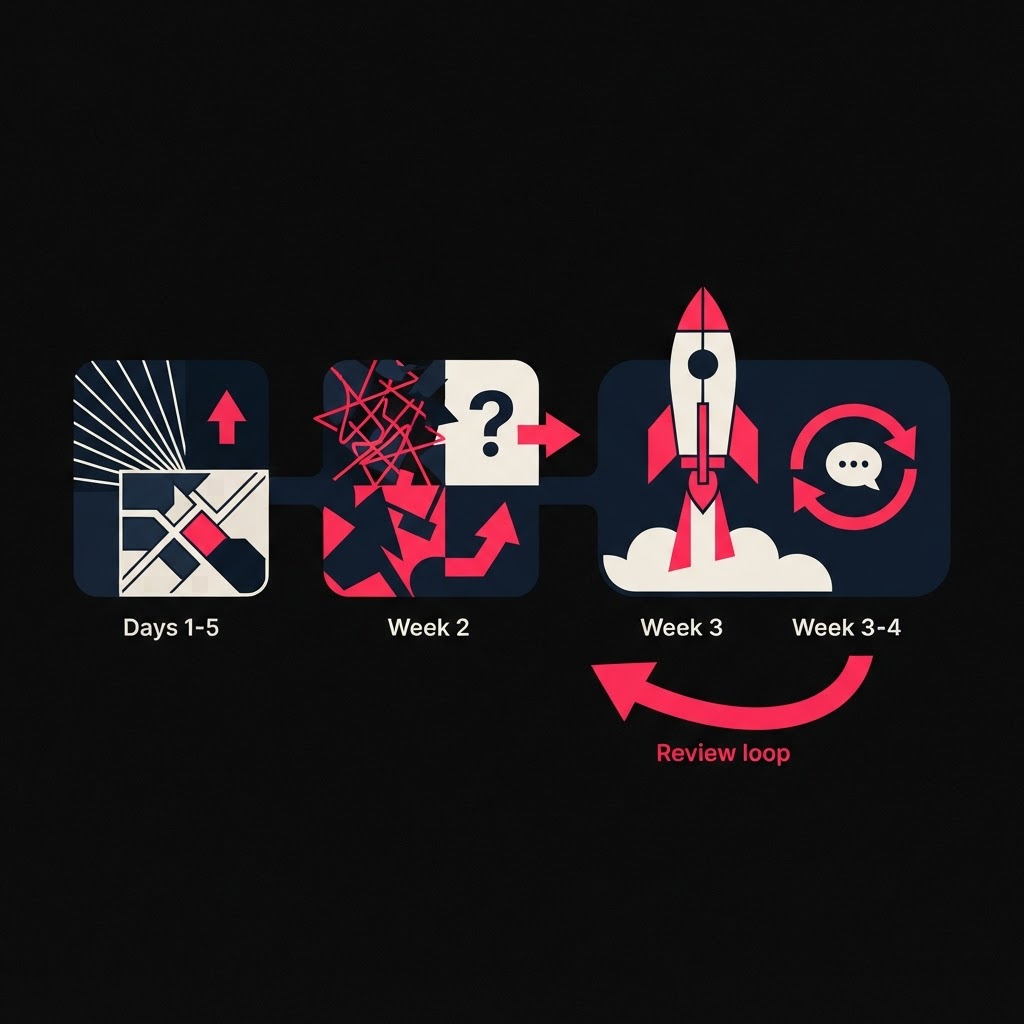
A 30-day system to learn fast as an intern
Learning science plus smart AI use, turned into a calendar.
Days 1 to 5: map the work
Information overload is normal. After 5 Intern Program puts it plainly: forgetting names and misreading an instruction in week one does not mean you are behind. Their best tip: at the end of each day, write the three things you most need to clarify before you can do your job, then find out who can answer them the next morning.
Add two things:
- A one-page map. Who owns what, which tools hold the truth, what the team is trying to hit this quarter. Redraw it from memory on Friday (that is Move 1 and Move 2 at once).
- A daily update. Dhaivat Ajwaliya recommends a short note every day: what you did, what is next, any blockers. It gives your manager a reason to correct you early, which is free feedback.
Week 2: struggle first, then ask
This is where most interns either ask too early or hide for too long. Use the 15-minute rule from SuperJobs Malaysia: try to solve the problem yourself for 15 minutes using your notes and internal docs, then ask, and say what you already tried. They note problem solving appears on 39% of internship listings, so this habit is also what employers are hiring for.
Struggling first is not wasted time. In the Anthropic study, the hand-coding group hit more errors and came out better at debugging. Fifteen minutes of honest confusion followed by a precise question beats an instant answer you will need again tomorrow.
Weeks 3 and 4: ship something real and ask for feedback
By week three, EarlyEdge Consulting argues, you have enough context to do work that gets noticed: finish the first major deliverable early and add one useful insight nobody asked for. At the end of week four, ask your manager directly whether you should be doing anything differently, while there is still time to act on the answer.
Keep a wins tracker from day one too. Every problem solved, every piece of praise, written down as it happens. You will not remember the details when the return-offer conversation comes.
Why real stakes make you learn faster
Here is the part most guides skip. The speed at which you learn depends less on your study tricks and more on what happens when you get it wrong. If your work goes into a drawer, mistakes cost nothing and teach little. If a real customer sees it on Friday, every error becomes a lesson you will not forget.
That is the bet behind EX EPIC Academy (formerly EX Venture Academy). Students from 26 nations work on 15 live projects with no grades and no exams. Interns take operational roles inside real ventures like Zero X in waste-to-energy, Gemino AI in automation and LIV Urban Sanctuary in wellness. The internship runs 4 to 6 months on-site in Bali, unpaid, with a potential path to a full-time role. AI is everywhere in that work, which is exactly why the rule above matters: the people who grow fastest use it to understand, then ship.
You do not need Bali to apply the principle. A third-year student profiled by India Today built an AI video editor that reached about 13,000 users, then emailed 30 startup founders directly. Thirteen replied, and he had an offer within a week. Building in public put real stakes on his learning before anyone hired him.
If you are weighing where to intern, our comparison of startup internship vs corporate internship covers how much real responsibility each one tends to give you. Remote options are coming soon in our guide to online AI internships for students.
You ship or you don't. Learn like it.
FAQ
How long does it take an intern to get up to speed?
Expect the first week to be mostly orientation and the second to be about asking good questions. By week three most interns have enough context to do noticeable work. The fastest ramp comes from short feedback loops: daily updates, early deliverables and asking your manager what to improve before the halfway point.
Is it okay to use ChatGPT or Claude to learn faster at an internship?
Yes, if your company allows it and you use it to understand rather than to delegate. Ask conceptual questions, request explanations with any generated code, and quiz yourself afterwards without the tool. If you hand over every hard problem, you will finish tasks without building the skill to check the output.
How many questions should an intern ask?
As many as you need, as long as each one is earned. Try first, check your notes and the docs, then ask with context about what you already tried. Write the answer down so you never ask the same question twice.
What should I do if I feel behind as an intern?
Feeling behind in the first weeks is the default, not a warning sign. Ask your manager what the most useful thing to focus on is, cut everything else, and run a short weekly review of what you learned. Clear priorities plus spaced review closes the gap faster than late nights.