You want an AI internship with no experience and every listing wants one to two years of it. Here is the thing the listing does not say: nobody who writes "experience preferred" can define what AI experience means for someone who was in school when the tools came out. We run a program that takes people with no prior experience into four to six months of real AI work. We read the applications. This is what we see, and what you can do about it in six weeks. ## The short answer No experience does not mean no ability. It means no proof. Build one checkable thing for one real person, then apply where beginners are screened on that thing: startups, research groups and immersive programs, not the big labs. Below: why the diagnosis is wrong, what the 2026 market actually looks like, what the people reading your application scan for, where the seats hide, and a six week plan that ends in real work instead of another application. ## Why "no experience" is the wrong diagnosis Most fields hide the work. AI does not. As one career guide puts it, for an AI engineer shipped projects are experience, because a recruiter can open your demo, read your code and watch your app answer a question. The same guide names the trap: job posts screen on years and titles because that is the cheap signal they are used to, but the field is so new that its most senior practitioners have only a few years in it. Your move is to give them a better signal so the years filter stops mattering. The people on the other side agree. A guide written for Indian freshers reports that hiring managers expect one thing from a beginner: evidence you can build something with AI tools, meaning a deployed URL, a repo with real commits and a 90 second demo you can walk through live. Without that, your application looks identical to the hundreds listing "Python, ML, AI, Deep Learning" after three YouTube playlists. We can confirm this from our side of the table. EX EPIC Academy takes applicants with no prior experience. The ones we reply to have a link, not a list. ## What the 2026 market actually looks like for beginners Let's not pretend. The honest picture has two halves. Demand for AI skills is rising fast. In NACE's Job Outlook 2026 Spring Update, a survey of 185 employers run in February and March 2026, hiring for the Class of 2026 is projected up 5.6%, nearly 70% of employers now use skills-based hiring, 13.3% of jobs and 10.5% of entry-level postings require AI skills, and demand for those skills has nearly tripled since autumn 2025. The same report says a plurality of 45% of employers rate the market only "fair", and that 27% of intern recruiting now happens in spring rather than autumn. Beginner seats are not rising with it. A guide from a startup job board collects the harder numbers: Handshake saw the share of internship descriptions mentioning generative AI rise more than fourfold since 2023, while the 2026 Stanford AI Index reports employment for software developers aged 22 to 25 down nearly 20% from 2024. More mentions, fewer seats. The community says it bluntly. A final-year student in India with an 8.0 CGPA and two deployed machine learning apps, a cancer classifier at 98% and a spam detector at 99.2%, posted that they still could not land a single internship. The replies: cold outreach and open source work better than portals, "it is very hard for entry right now", and one harsh line about their project being "nothing special". Read those together and the conclusion is not "give up". It is that the screen has moved from "do you have experience" to "how good is your proof". That is a bar you can clear on purpose. ## What the people reading your application actually scan for ### The one project that counts The fresher guide above asked recruiters at Chennai and Bengaluru product companies what gets a beginner shortlisted. The pattern: a live project URL, the specific tools used, one project explained end to end, and a personalised four sentence note. The job board guide's comparison of employers says the same thing from a different angle: startups screen first on a shipped project or demo, big labs on school and structured interview performance, campus research groups on grades in key courses plus a short email showing real interest. So why did the Reddit poster's 98% classifier not work? Because it solves a dataset, not a problem. Nobody had breast cancer screening done by that app. The reviewers who read the repo saw a tutorial with a high score, and said so. The project that counts is smaller and stranger: a quiz that an actual tutor uses, a document summariser a real clinic runs, an automation that killed a weekly task for a named small business. One real user beats one impressive metric. Our guides on how to build a portfolio with no experience and AI project ideas for beginners walk through picking that problem. ### What gets ignored The recruiter table is just as useful for what it leaves out. GPA above a floor is rarely decisive. Generic skill lists with no project behind them are skipped. Five half finished tutorial clones count for less than one finished thing. And certificates with no shipped work attached are explicitly listed under "ignore". Proof over paper is not our slogan, it is the hiring pattern. ## Where the beginner seats actually are ### Big AI labs: mostly not for you yet Read the eligibility lines. Google Research describes its research internships as aimed at PhD students, while its Student Researcher program is open to bachelor's and master's students, and many undergraduates reach AI teams at large companies through a software or data internship rather than an "AI intern" title. Big labs recruit early on a fixed calendar and filter on school. Spend your first application cycle elsewhere. ### Startups: rolling, late, and proof first Startups post fewer internships, later, often without a clear label, and a seed stage company with no posted role will still take a strong student for a summer. The invisible job market is real: almost nobody posts a job titled entry level AI engineer, the openings hide inside ordinary software teams that just decided to add AI to an existing product. Search for the work, not the title: LLM, RAG, chatbot, agent, automation. Then email the person who owns it. ### University research groups: the overlooked door Faculty labs need help cleaning data, running experiments and building evaluation sets. They recruit through department lists and direct email, and they screen on reliability and curiosity over months rather than on a polished demo. In the US, the NSF Research Experiences for Undergraduates program funds summer sites with stipends and often housing, with most deadlines between January and March, but eligibility is limited to US citizens and permanent residents. International students should look at their own campus programs instead. ### Immersive programs: internship and training in one The fourth lane is the one we run. EX EPIC Academy places people with no prior experience inside live ventures for four to six months, on site in Bali, with 78 open positions across AI and automation, consulting, engineering, sales, research and content, unpaid with potential for a full time transition. The careers page opens with the rhythm you are signing up for: "Monday morning, the reset. What did you ship. What broke. What are you building this week." Interns are placed in operational roles, not shadowing seats. The founding press coverage names placements at Zero X in waste to energy, Gemino AI in automation and LIV Urban Sanctuary in wellness. The parent group reports 250 plus operators trained and deployed through the Academy, inside what the founder describes as fifteen companies and eight brands built as one ecosystem, with the Academy as the talent engine at the centre. Unpaid is a real cost and deserves a real conversation, which is why we wrote about whether a startup unpaid internship is worth it separately. The short version: unpaid plus real responsibility plus a path to a paid role can be worth it. Unpaid plus a certificate is not. If the lane appeals and you are weighing destinations, our guide to an AI internship abroad covers what a real one looks like. ## A 6 week plan that ends in real work, not an application The fresher guide's plan runs 30 days from zero to a deployed app plus 15 to 20 applications. The pieces are right. We stretch it to six weeks because the step everyone rushes, finding a real user, is the step that decides whether the project counts. ### Weeks 1 to 2: build one thing for one person Find one person with one annoying task: a tutor, a club, a family shop, a lab. Build the smallest AI powered thing that removes it, using free tiers. The fresher guide suggests a resume reviewer, a vocabulary quiz with generated questions, a lecture note summariser or an FAQ chatbot for a local business, built with an AI coding editor, a model API, a hosted frontend and a public repo. Any of those works if a named human uses it. Deploy it. Get them to use it twice. ### Weeks 3 to 4: make it checkable Add one feature based on what the user complained about, because iteration is what separates a product from a clone. Record a 60 second demo of yourself using it. Write a short "how I built this" post that covers your prompt strategy, what failed and how you debugged it. Put the live URL at the top of your CV. This is the stage the Reddit poster skipped: the repos were public, but nothing told a reviewer why anyone should care. ### Weeks 5 to 6: 20 targeted applications and 20 direct emails Do not mass apply. Pick 20 startups, research groups or programs whose work you can describe in a sentence, apply, then send a short note to the person who owns the work. The note we reply to at the Academy has four parts: the thing you built, the link, one specific reason you want to be here, and one thing you will do in your first week. We cover the format and the notes that got a reply in cold email for a startup internship. When you get a call, open with the demo and run it live. If the internship route stalls, the same proof carries into entry level AI jobs with no experience, because the screen is identical. ## What an AI internship with no experience looks like from the inside The first Monday at the Academy, nobody asks for your transcript. You are assigned to a live venture, you get a real task with a real deadline, and on Friday you present what shipped to people who will use it. Monday the slate resets. Some weeks you break things. That is the point: you leave with months of shipped work a stranger can inspect, which is exactly the proof the next application needs. You ship or you don't. That is the whole curriculum, and it is the same bar every recruiter in this article is applying. ## FAQ ### Can I get an AI internship with no experience and no CS degree? Yes, if you aim at the right lane. Startups and immersive programs screen first on a shipped project, and campus research groups on grades in relevant courses plus a short, specific email. Big AI labs screen on school and structured interviews, so leave those for a later cycle. ### Do I need to know machine learning math to get an AI internship? Not for most beginner seats. Recruiters at product companies want someone who can ship an AI feature, call a model, handle errors and explain the decisions. Theory matters for research and lab roles, and you can learn it on the job once you are in. ### Are AI internship certificates worth anything? On their own, very little. Recruiters list certificates with no shipped work under what they ignore. A certificate next to a live URL is fine. A certificate instead of one reads like a tutorial. ### When should I apply for an AI internship? Big companies recruit early on a fixed calendar. Startups and research groups hire rolling, close to the start date. NACE reports 27% of intern recruiting now happens in spring, so a missed autumn is not a lost year. ### Is an unpaid AI internship ever worth it? Only when the work is real and the exit is named: a live venture, responsibility you can describe, and a stated path to a paid role. Busywork that ends in a certificate is not worth free labour, whatever the brand on the letterhead.
AI Internship With No Experience: How to Get One in 2026
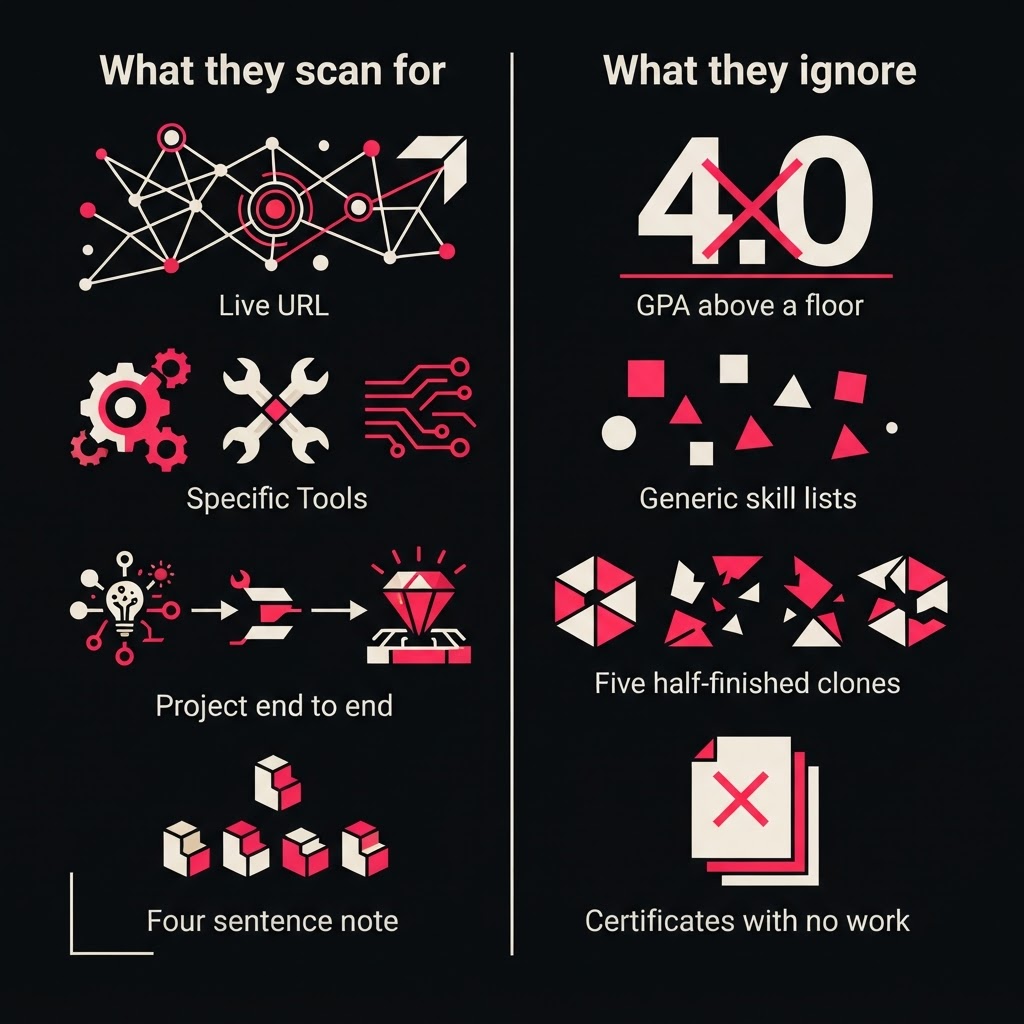
AI internship with no experience: what recruiters scan for, the one project that counts as proof, where the seats hide, and a program that takes beginners.
Want to build this way instead of reading about it? Email academy@exventure.co.
Online · Las Palmas · Bali
Three days with the operators building what replaces the old map: academy alumni, portfolio founders and the people who fund them, in one room.
EX Venture Group and its affiliated service companies are incorporated and operate in the United States and Europe only. They do not operate in Indonesia and do not provide services into or from Indonesia. All Bali-based operations, including EX Epic Academy, are solely managed and operated by EPIC Solutions PT.
▸ UU PDP No. 27/2022 · UU ITE · Cookie consent required
We use essential cookies to operate this site and analytics cookies to improve it. In line with Indonesia’s UU PDP (Personal Data Protection Law, UU No. 27 of 2022), your consent is required for non-essential cookies. See our Privacy Policy.