Most advice on how to learn AI skills for jobs is a course list. Take this certificate, learn that tool, add both to your LinkedIn. Then you apply, and the hiring process asks for something no course list mentioned.
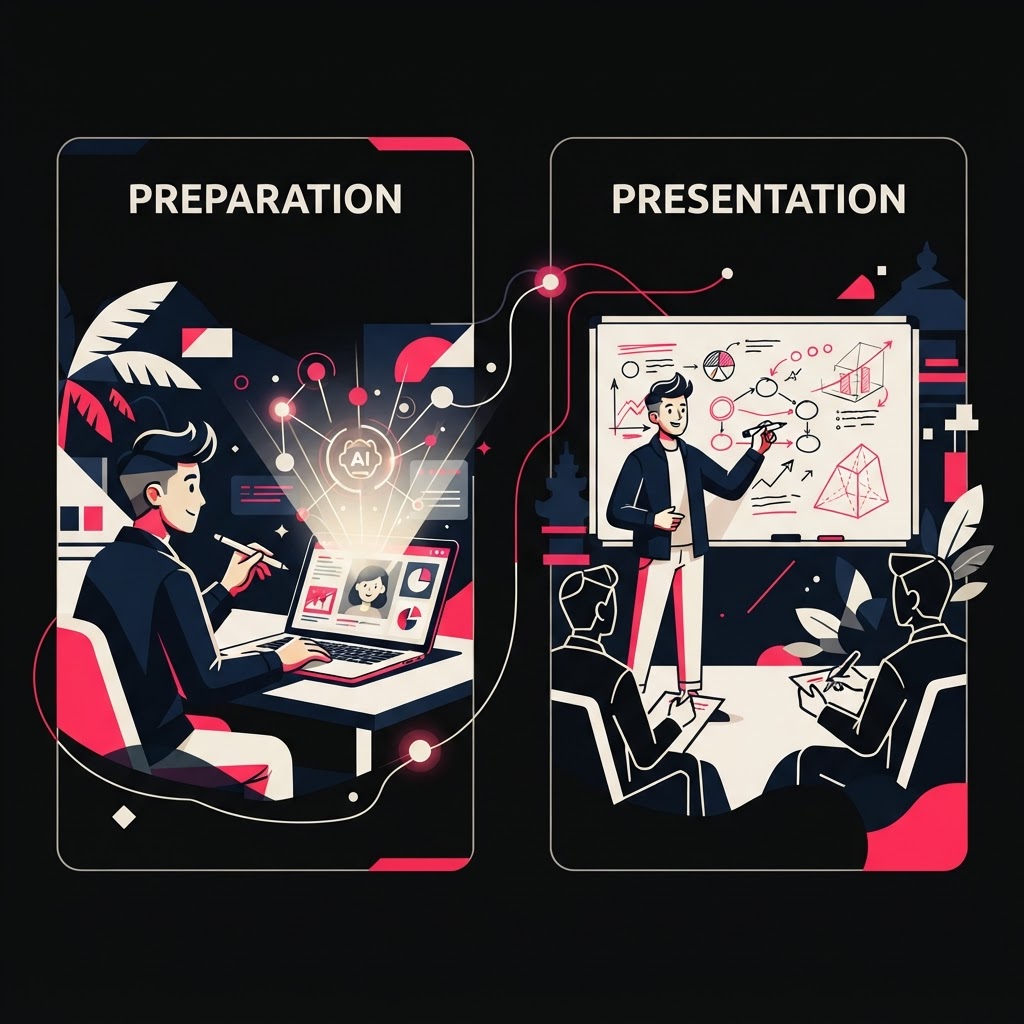
Here is what it asks for. Employers now test AI skill twice. Once with AI in your hands. Once with it taken away. And above both, they rank something no course can hand you: real work.
So this guide starts with the tests, not the tools. Learn backwards from what gets scored.
The short answer
To learn AI skills for a job, pick one real workflow in the field you want, learn to do it end to end with AI, practise the same judgment without AI, and ship the result to someone who depends on it. Then describe that work in terms of decisions and outcomes, not tool names.
That is the whole method. The rest of this page is the evidence for it and the plan.
What employers actually test in 2026
Test one: can you work with AI
Gartner predicts that by 2027, 75% of hiring processes will include certifications and testing for workplace AI proficiency during recruiting. Three in four. That is not a nice-to-have anymore. That is a gate.
What does the test look like? Canva published theirs. The company replaced its classic computer science screening with a new competency called AI-Assisted Coding, where candidates are expected to use their own AI tools on realistic product problems. Interviewers score five things:
- Do you understand when and how to use AI effectively?
- How well do you break down complex, ambiguous requirements?
- Can you make sound decisions while using AI as a multiplier?
- Can you find and fix issues in what the AI produced?
- Can you make the output meet production standards?
Read that list again. Not one line asks which tool you know. Every line asks about judgment.
The same logic runs inside companies. Shopify's CEO told staff that AI use now counts in performance reviews, and that teams must show why AI cannot do a job before asking for more headcount. If that is the bar for people already hired, it is the bar for you.
Test two: can you think without it
Here is the part the course lists skip. Gartner also expects half of global organisations to require "AI-free" skills assessments to check whether candidates can still think critically on their own, because heavy GenAI use erodes that skill.
So the same employer may hand you Claude in round two and take it away in round three. If all your practice happened with a chatbot open, round three is where you fall.
What they rank above both
Strada surveyed nearly 1,500 executives and senior talent leaders about entry-level hiring. The results should rewrite your study plan:
- Employers rated AI literacy the least important skill they evaluated. Critical thinking and communication ranked most important.
- Related work experience, such as internships or project-based learning, was the most valued signal. A 4.0 GPA with awards and no work history ranked last.
- Nearly three times as many leaders expect AI to increase entry-level hiring in 2026 as expect it to decrease it.
- More than 40 percent say AI has increased the analytical responsibilities given to entry-level staff.
Put the two findings together. Employers barely care about "AI literacy" as a label, and yet they are about to test for AI proficiency almost everywhere. That is not a contradiction. They do not want someone who knows about AI. They want someone who does real, analytical work, with AI and without it.
The demand is real, too. NACE reports that demand for AI skills in entry-level jobs nearly tripled since fall 2025. The skill is wanted. The label is not.
The five AI skills hiring actually scores
Canva wrote its list for engineers. Strip out the code and it works for almost any job. Here is the translation.
1. Decompose. Take a vague request ("make our onboarding better") and turn it into steps an AI can help with. Most bad AI output starts with a bad brief, and the brief is yours.
2. Choose. Know which steps AI should do, which it should draft for you, and which it should never touch. Choosing wrong is how confidential data ends up in a chatbot.
3. Verify. Catch the confident mistake. A made-up citation, a formula that looks right, a summary that drops the one clause that matters. This is the skill interviewers probe hardest, because it is the one that protects the company.
4. Own. Canva's rubric asks whether your output meets production standards. That means you own it, whoever or whatever wrote the first draft. "The AI said so" is not an answer in a review.
5. Explain. Say what you decided and why, in plain language, to someone who did not watch you work. This is the communication skill Strada's employers rank at the top.
Notice that none of these can be learned by watching a video. Each one needs a real task with a real consequence. That is the clue to how to learn them. For a fuller breakdown of the definitions behind them, see what AI skills actually are, and for the role-by-role list, the guide to skills required for artificial intelligence jobs.
How to learn AI skills for jobs: a four-stage plan
Stage 1: pick your lane
Not every AI job needs the same depth. Dataquest splits the field into three lanes: builders who train models, integrators who build products on existing models, and AI-powered professionals who apply AI inside a domain they already know. According to Lightcast data cited in that guide, 51% of postings demanding AI skills sit outside IT, and roles requiring AI skills pay 28% more than comparable roles, nearly $18,000 a year.
So first decide: do you want to build AI, or use it to do a job better? If it is the second, you can learn AI without coding and start this week. If it is the first, you need Python and a longer runway, and a step-by-step AI learning roadmap will save you months of wandering.
Stage 2: learn on one real workflow
Pick one workflow from the job you want. A marketer: research a competitor, draft a campaign brief, test three hooks. An analyst: clean a messy dataset, find the three numbers that matter, write the memo. An operator: turn a manual weekly report into an automated one.
Do that one workflow with AI, again and again, until your output is good enough that someone would use it. One workflow done well teaches all five skills. Ten half-finished courses teach none.
If you are stuck for a starting task, pull one from these AI project ideas for beginners, but pick the one closest to the job you want, not the flashiest.
Stage 3: practise without AI on purpose
Once a week, do a smaller version of the same task with the AI closed. Write the memo from your own notes. Sanity-check the numbers by hand. Explain your recommendation out loud in two minutes.
It feels slow. That is the point. This is the muscle the AI-free round tests, and it is also what makes you good at step three, verification. You cannot catch the AI's mistake in work you could not do yourself.
Stage 4: ship work someone depends on
This is the stage most people skip, and it is the one Strada's employers weigh most. A project in a folder is practice. A deliverable that a real team used, with a real deadline and a real person who would have noticed if it was wrong, is experience.
Internships count. Freelance jobs count. A real project for a local business or a student society counts. What does not count is a tutorial you finished alone.
How to prove it when you apply
When you pass both tests in practice, the job is to make that visible.
On your resume, write outcomes, not tools. "Used ChatGPT" says nothing. "Cut the weekly report from four hours to forty minutes by building an AI-assisted workflow, then checked every figure against source" shows decomposition, verification and ownership in one line. The full method is in how to put AI skills on your resume.
In your portfolio, show the before, the process and the after. Include one place where the AI got it wrong and you caught it. That single example does more than any certificate. If you have nothing to show yet, here is how to build a portfolio with no experience.
For the interview, rehearse both rounds. Solve a task with your AI tool while narrating your choices out loud. Then solve a smaller one with nothing but a pen. Ask the recruiter which format they use. Some will tell you.
What this looks like in Bali
We built EX EPIC Academy around this exact gap. Participants from 26 nations work on 15 live projects. No grades. No exams. Real ventures, real stakes.
Interns take operational roles at real ventures inside the ecosystem, such as Zero X in waste-to-energy, Gemino AI in automation and LIV Urban Sanctuary in wellness. (The press coverage uses our former name, EX Venture Academy.) Nobody grades a prompt. A founder reads your output, and it either ships or it does not.
That is the whole design. AI tools open for the build. Judgment in the room when you defend it. Real work at the end, the thing employers rank above everything else. It runs for 4 to 6 months on-site in Canggu, across tracks from AI and automation to marketing, consulting and engineering.
You do not need Bali to follow the plan above. But you do need stage four. Find the place where your work gets used.
FAQ
How long does it take to learn AI skills for a job?
For the AI-powered professional lane, where you apply AI inside a field you already know, Dataquest puts the start at days and job-ready fluency at weeks to a few months. A full technical route into AI engineering takes roughly 8 to 9 months at about 5 hours a week. The real clock starts when your work gets used by someone else.
Do I need to learn to code to get a job using AI?
Not for most AI-enabled roles. Coding is required if you want to build or integrate AI systems, but more than half of postings asking for AI skills are outside IT. Marketing, operations, finance and HR roles test whether you can use AI well and check its output, not whether you can write Python.
Are AI certificates worth it for getting hired?
A certificate can help you through a screening filter, and Gartner expects formal AI testing to spread fast. But employers in Strada's survey ranked real work experience as the strongest signal and AI literacy as the weakest skill. A certificate gets you to the test. Shipped work passes it.
Can I use AI during a job interview?
It depends on the employer, so ask. Canva expects engineering candidates to use AI tools in its technical interview. Other employers are adding AI-free assessments to test independent thinking. Prepare for both formats, and never use AI covertly in a round where it is not allowed.