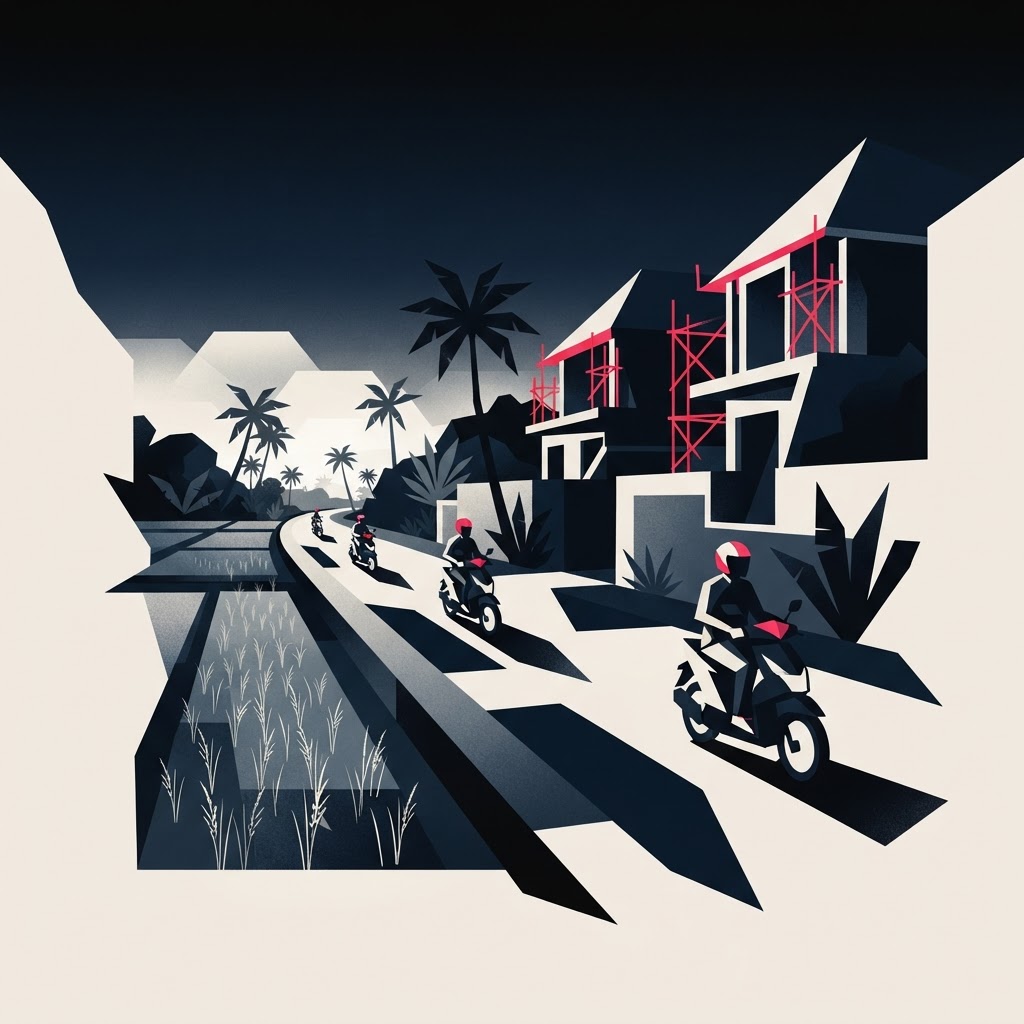
Is Bali ruined? You have seen the videos. The sunset crowds, the gridlocked lanes, the "Bali reality vs expectations" reels, the Reddit threads from people who were there in 2015 and say never again.
We are not neutral on this. We run EX EPIC Academy out of Canggu, the exact village those headlines are about, with people from 26 nations working on 15 live projects. We also bring people here, which is the best reason not to trust us blindly. So this piece starts with what is genuinely broken, then what is overstated, then whether it is still worth coming. Sources on every number. Judge for yourself.
The short answer: not ruined, overloaded in the places you have heard of
Bali is not ruined. Parts of it are badly overloaded, and those parts happen to be the ones on your feed.
The most useful reframe comes from local experts quoted by the Asia Media Centre: the issue is less overtourism than overconcentration. Most visitors pile into the southern belt from the airport through Seminyak, Canggu and Ubud, while the north and the mountainous interior get a fraction of the traffic.
That is the honest verdict. The rest of this article is the evidence, including the bits that do not flatter Canggu.
What is genuinely broken
No spin here. These problems are real, measurable, and we live with most of them every day.
Traffic
This is the one you feel first. City AM, reporting from Canggu this month, puts the 12 mile trip from the airport at anywhere between 45 minutes and over two hours. Kiki Journey clocks Canggu to Ubud at 90 minutes at noon and three hours at 17:00. The Asia Media Centre piece says peak traffic in parts of Canggu and Seminyak can drop to little more than walking pace.
Our experience matches. If your day depends on crossing Canggu at 17:00, your day is broken. The fix is not heroic: live close to where you work, move early, and stop scheduling anything across the Batu Bolong shortcut at sunset.
Water and rice fields
This is the problem tourists do not see, and it is the serious one.
- Tourism consumes over 65 percent of Bali's fresh water, per Lonely Planet, for pools, gardens, laundry and drinking.
- In Canggu itself, farmland has declined by 60 percent while land development increased by 69 percent, according to The Inertia. Rice paddies recharge the aquifer. Concrete does not.
- Kiki Journey puts Bali's rice field loss at roughly 6,500 hectares in five years.
- The Asia Media Centre reports some coastal aquifers declining, and residents describing wells running dry in peak season.
In September 2025 this stopped being abstract. Flash floods killed at least 18 people, per The Guardian, and Lonely Planet links the damage to lost rice fields, uncontrolled development and poor waste management.
Crowds and construction
The numbers explain the noise. The BBC counted 3.8 million foreign visitors in 2014 and 6.3 million in 2024. City AM puts 2025 at just under 7 million, up 173 percent in a decade. Lonely Planet notes that is on an island of 4.5 million people. July 2025 alone brought 697,000 international arrivals, a record month, per Kiki Journey.
All of that lands on roads and villages that were never planned for it. The BBC quotes a Balinese woman who says riding past her old resting spot now fills her with sadness: "I feel that Bali is being eroded day by day." That sentence matters more than any reel.
Waste
Kiki Journey notes that monsoon season still washes plastic onto the western beaches every January and February, and that waste infrastructure has not kept pace with 7 million visitors. If you arrive in January expecting the postcard beach, you may get the other one.
What the headlines overstate
Here is where the "ruined" take falls apart: it treats Bali as one place.
Bali Escape puts it well: the debate swings between articles declaring the island ruined and defensive replies insisting nothing has changed, and neither describes what is happening. The pressure is real in specific bottlenecks at specific times: Canggu's main roads at rush hour, Uluwatu viewpoints at sunset, the queue for the Lempuyang photo spot. Step outside them and Sidemen's rice terraces, Munduk's waterfalls, most of East Bali and the north coast around Lovina run at a far calmer pace.
Kiki Journey's verdict is the sharpest line on the whole SERP: the Bali that is "ruined" is a 15 kilometer strip of the southwest coast, and the rest of the island is as intact as ever.
A Bali tourism observer interviewed by VOI makes the same point from the other side. What Bali faces is "not a crisis of charm, but a crisis of governance": too many people arriving faster than roads, transport and spatial planning can grow. That is a fixable kind of problem. Ruined is not.
What Bali is doing about it
Real policy moves, not just slogans. Whether they work is too early to say, so treat this as a list of commitments, not results.
- Rice field protection. After the 2025 floods, the governor announced that no new hotels or restaurants could be built on productive land, especially rice fields, per The Guardian.
- It became law. Emerhub reports that Regional Regulation No. 4 of 2026 makes converting productive rice fields into commercial property such as villas a criminal offence, targets the nominee schemes foreigners used to control land, and freezes remaining conversion permits. Their figures: about 64,474 hectares of standard rice field left as of February 2026, down from 70,996 in 2019.
- A tourist levy. Since 2024, every visitor pays IDR 150,000, which goes towards culture, waste management and environmental restoration, per Lonely Planet.
- Plastics and behaviour. The BBC reports a ban on single use plastics and published guidelines for respectful visitor behaviour.
None of this untangles Canggu traffic tomorrow. But an island that criminalises villa sprawl is not one that has given up.
The uncomfortable part: long stayers are in this story too
Most "is Bali ruined" articles are written for holidaymakers. Ours is read by people thinking about staying for months, so we owe you this part.
Lonely Planet is direct: many Balinese regard digital nomads "with cautious tolerance rather than outright enthusiasm". Remote workers stay longer and spend more, but the influx has pushed up rents and made it harder for locals to afford their own neighbourhoods. Canggu is the example they use, a fishing village that now caters almost entirely to nomads.
We are part of that picture. Pretending otherwise would make everything above worthless. What we can control is how we show up:
- Live like a resident, not a content shoot. Rent long term from locals, eat at warungs, learn enough Bahasa to say more than thank you.
- Stay off the scooter when you can. Walkable housing near your work cuts your share of the traffic and your stress.
- Respect the calendar. Ceremonies close roads. That is the island working, not an inconvenience.
- Pay the levy and use less water. The pool villa is the single most water hungry choice you can make.
Our guide to how to live and work in Bali goes deeper on the practical side of this.
Should you still come? A scorecard by who you are
The honest answer depends on what you are coming for.
| You are | Verdict | Why |
|---|---|---|
| A 7 day holiday, Canggu and Uluwatu only | Probably disappointing | You will spend it in the bottlenecks |
| A holiday that includes Sidemen, Munduk or the north | Still excellent | That Bali is largely intact |
| A long stay to rest | Good, outside the south | Quieter regions, slower life |
| A long stay to build, learn or ship work | Strong, if you live near your work | Density of builders and coworking is the upside of the crowds |
That last row is our bias, and here is the reason for it. The same density that jams Canggu's roads also packs it with founders, operators and coworking spaces. If you are here to ship, that density is the point. Our programs run 4 to 6 months on site in Bali, inside real ventures, because that is long enough to build something real and to learn the island beyond the reels.
If you are planning that kind of stay:
- Check whether a structured work from Bali program fits better than going solo.
- Budget honestly with our cost of living in Bali for founders.
- Pick a base near where you will actually work, using our list of the best working cafes in Bali.
Bali is not ruined. It is crowded, strained and changing fast in a few famous places. Come with your eyes open, stay out of the 17:00 traffic, and leave the place a little better than the reel you came for.
FAQ
Is Canggu ruined?
No, but it is the busiest and most built up part of the island, and the traffic is the worst. City AM's answer to "is Canggu done?" was "Hardly". Live off the main strips, surf early, and it still works.
Where in Bali is still quiet?
Sidemen, Munduk, Amed, Lovina and most of East Bali beyond the main temple loop. Lonely Planet and Bali Escape both point to the north and east as far less crowded.
When is the best time to visit Bali to avoid crowds?
The shoulder seasons, April to May and September to October. Lonely Planet recommends avoiding the June to August peak, when attractions and beaches are most packed and prices rise.
Do I have to pay the Bali tourist tax?
Yes. Every foreign visitor pays IDR 150,000, online before arrival or at Ngurah Rai airport. Lonely Planet notes it funds cultural preservation, waste management and environmental restoration.