
Almost every guide to the cost of living in Bali prices a tourist. Founders are not tourists. You run two budgets, not one: the personal burn that keeps you alive, and the business burn that keeps the company alive. Skip the second and your runway math is wrong before you even land. We build from Canggu every day, so here are the honest 2026 numbers on both sides of the ledger, plus the part nobody does for you: what they buy you in months.
The short answer: what Bali costs a founder in 2026
Three tiers. Each one counts personal spend plus business spend, because your company does not run on nasi campur and scooter fuel.
Lean solo builder: $1,650 a month. A private studio, a scooter, mostly local food, a basic hot desk and a minimum software stack. Martin Ebongue, who has run four businesses from a Canggu coworking space since 2022 and publishes his actual ledger, stress-tested that floor at $1,650 and is blunt about what sits below it: anything cheaper, and you start making compromises that hurt the business itself.
Operator standard: $2,800 a month. Ebongue's middle tier, and the one most solo founders with revenue or a small raise actually land on: a one-bedroom apartment, a dedicated coworking desk, a mixed diet, basic international health insurance and a $250 software stack.
Founder with a family: $4,000 to $4,500 a month. His own all-in number is $4,162, split $3,080 personal and $480 business across four ventures, with school fees inside the personal side.
For contrast, here is the resident-only view of the same island. Explore Canggu's 2026 breakdown puts a budget lifestyle at $900 to $1,200 a month and the digital nomad standard at $1,500 to $2,500. Those numbers are honest. They are just not founder numbers. The difference between the two columns is your company.
Your personal burn, line by line in Canggu
Housing: the biggest line and the biggest trap
Rent is where the whole budget is won or lost. Explore Canggu's current ranges: a guesthouse or homestay room at $300 to $500, a one-bedroom private pool villa in Batu Bolong or Berawa at $1,300 to $2,300, and the same thing in Pererenan or Seseh at $1,000 to $1,600. Freaking Nomads, reporting from six weeks on the island in 2026, puts a Canggu one-bedroom villa at $700 to $1,200 on annual-style leases, with month-to-month bookings costing meaningfully more.
Now the trap. Bali rent is not billed monthly. Landlords typically want 6 to 12 months upfront to give you that monthly rate, so a $1,200 villa is not a $1,200 decision. It is a five-figure wire on day one. Ebongue's deposit alone was $7,200. Plan it as working capital, not as a recurring cost.
Food, scooter and utilities
A warung plate runs $1.50 to $2.50 and a western cafe meal $5 to $10. A Honda Scoopy or Vario rents for $65 to $100 a month and petrol is close to free.
That tempts every new arrival into the $90 food budget. Do not believe it. Ebongue budgets $480 a month for food and explains why: nobody eats warung three times a day for two years. You burn out in a fortnight and start ordering delivery. Plan closer to his $480 than to the warung fantasy. Add roughly $120 a month for electricity, water, home fibre and mobile data.
Health insurance and the visa line
Two lines that founders under-budget because employees never see them. Lean international cover starts around $45 to $55 a month per Freaking Nomads. Proper international coverage that still works when you fly to Singapore for a meeting costs Ebongue $185 a month, and he rates it non-negotiable for an operator after having to fly home for a procedure.
Visas amortise to $30 to $50 a month at the tourist-extension end. Ebongue carries a $165 monthly buffer covering renewal, an accountant who understands Indonesian structures, and the annual trip some setups require. Somewhere between those two is your real number.
The budget nomad guides never show you: what the business costs
This is the section missing from every cost of living page ranking for this topic. It is also the one that decides whether you can ship.
Coworking is a business line, not a lifestyle one
Silicon Bali's practical setup guide puts a hot desk at $150 to $300 a month, or $800 to $1,500 for a one-bedroom villa with a proper work area if you prefer deep work at home. Pay for the tier that includes a phone booth if you take calls daily. Cafe hopping looks cheap until you lose an investor call to a blender at 11am.
The software stack
Here is the number no lifestyle guide prints. Ebongue runs the entire tooling stack for four businesses on $480 a month, about $120 per business, covering docs, project management, automation, email, payments, banking, storage and AI assistants. The minimum viable version for a solo founder on free tiers is about $16 a month.
So the honest framing is this: your $1,000 cost of living figure does not include what the business itself costs to run. Add it. At the operator tier that is another $250 a month on top of the personal column, and it scales roughly linearly as you add ventures.
Founder travel: Jakarta and Singapore
Unicorn Embassy's 2026 founder analysis describes the pattern most successful Bali-based founders actually run: live in Bali for the operating environment, fly to Jakarta for business development with Indonesian customers, fly to Singapore for institutional investor relations. Bali is home base, and those two cities are work travel.
Nobody prices that line, so we will say it plainly. If your customers or investors sit in Jakarta or Singapore, put a travel line in your budget from month one. The frequency is yours to choose. The line is not optional.
Runway math: what the Bali number actually buys you
Cost of living is the wrong unit. Months are the right one. Runway is the only input a pre-seed founder cannot cheaply raise more of.
The Bali Startup and Tech Community's 2026 ecosystem guide states the comparison directly: a founder lives well on $2,000 to $3,000 a month in Bali, against $6,000 to $8,000 in Austin, $8,000 to $10,000 in Lisbon and $10,000 plus in Dubai.
Take $60,000 of savings and divide it by the midpoint of each band:
- Bali at $2,500 a month: 24 months
- Austin at $7,000 a month: about 8.5 months
- Lisbon at $9,000 a month: about 6.5 months
- Dubai at $10,000 a month: 6 months
Same founder, same laptop, same product. Two years of shots on goal instead of two quarters. That is the entire argument for building a startup from Bali, and it survives contact with the real line items above.
Four costs that blindside founders
The upfront cash shock. Covered above and worth repeating, because it is the single most common budgeting mistake: months of rent in advance plus a deposit turns your first month into your most expensive quarter.
High season. Accommodation prices jump 30 to 50 percent in July, August and late December per Explore Canggu, and short-term availability collapses. Arriving in peak season on a short lease is the most expensive possible way to start.
Moving your own money. Sending funds from a Western bank to an Indonesian account can cost 4 to 7 percent in fees and conversion losses if you do it naively. On a $5,000 transfer that is real money, monthly. Multi-currency rails fix it, and Silicon Bali notes you cannot open a local bank account at all without a KITAS stay permit, so most founders run international tools plus local payment apps.
The visa income gate. The cheap base is not automatically available to you. Unicorn Embassy details the E33G Remote Worker Visa: up to one year, but it requires $60,000 minimum annual income, an employment contract with a company based outside Indonesia, and $2,000 sitting in your account for the prior three months. The Second Home Visa runs up to ten years against a $130,000 deposit or a property purchase. Neither is designed for a pre-revenue founder. Verify current rules before you book anything, because Indonesian visa policy moves fast.
What we actually see from Canggu
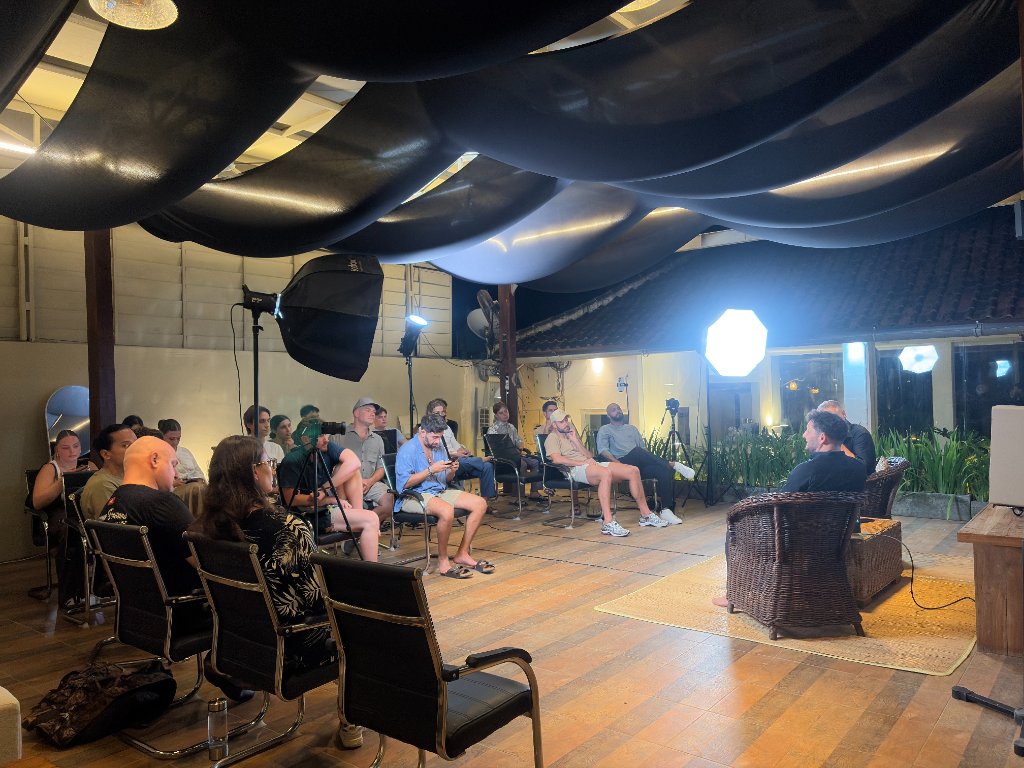 An evening session at our Canggu space. The costs in this article are the ones we pay.
EX EPIC runs ventures and the Academy from Canggu, with builders from 26 nations working on 15 live projects. So we watch people budget for this move constantly, and the thing they get wrong is almost never rent. It is the two things above: the second budget, and the size of the first cheque.
There is also a cost nobody puts in a spreadsheet. Arriving alone means paying for your own coworking, your own villa, your own network from scratch, and eating the loneliness of a community that turns over every quarter. Entering through a team that already operates here removes most of that overhead at once. That is the same talent arbitrage logic founders use, applied one step earlier, and it is why our 4 to 6 month immersive roles drop people straight into live ventures. If you want to know who else is on the island first, start with Bali's tech and startup scene.
FAQ
How much cash do you need upfront to move to Bali as a founder?
Far more than one month's rent. Landlords typically want 6 to 12 months in advance plus a deposit, so a $1,200 villa can mean a five-figure transfer on arrival. Add visa fees, a scooter deposit and a buffer for the first weeks before you find a long-term place. Budget that first cheque as a separate number from your monthly burn.
Can a founder live in Bali on $1,000 a month in 2026?
As a resident, barely. That budget buys a guesthouse outside the main hubs, mostly warung food and cafe wifi. As an operator, no. It leaves nothing for coworking, international health insurance or any business tooling, which is exactly the spend that makes the move worth making.
Is Canggu or Ubud cheaper for founders?
Ubud, by a clear margin. A modern one-bedroom runs about $500 to $900 there against $700 to $1,200 in Canggu, roughly 20 to 30 percent less for comparable housing. You trade the denser founder network, the events and the surf for rice terraces and quieter mornings.
What does it cost to hire someone locally in Bali?
Silicon Bali puts junior to mid-level design, development and marketing roles at $500 to $1,500 a month, with senior roles at $2,000 and up. Quality varies widely, so hire on shipped work rather than CVs, and start with a paid trial project.
Do costs in Bali change with the season?
Sharply. Accommodation climbs 30 to 50 percent during July, August and late December, and the best long-term places are gone before peak season starts. If you can, lock a longer lease before those months rather than during them.