You searched for entry level AI jobs with no experience and got two kinds of answers. Job boards full of listings that want "0 to 2 years". And listicles of 14 or 19 roles, most of them written by platforms that sell the first role on the list. Neither tells you the thing that matters: which of these jobs is a first step in a career, and which is a side gig with an AI label on it. So here is the map instead of the list. ## The short answer There are three doors into AI work when you have no experience, and they open for different people. 1. The gig door. Annotation, evaluation, AI training. Fastest to open, lowest ceiling. 2. The AI user door. Your field, plus AI: operations, analysis, marketing, support. The biggest door and the one growing fastest. 3. The builder door. Junior roles at AI startups and agencies. The smallest door, screened almost entirely on what you have shipped. Most real entry level AI jobs are not titled "AI". And "no experience" is rarely a skill problem. It is a proof problem. Every door below opens with a different kind of proof. ## What the 2026 market actually looks like Proof over panic means looking at both halves of the data. ### The squeeze is real A widely cited Stanford analysis by Brynjolfsson and colleagues found a 16% decline in entry level jobs in AI-exposed fields in the US since late 2022, and the World Economic Forum notes those declines started before ChatGPT launched, so AI is not the only cause. Looking forward, 49% of CEOs in PwC's Global CEO Survey expect AI to decrease junior hiring over the next three years, against 12% for senior hiring. If you want the full answer to that fear, we wrote it up separately: whether AI will replace entry level jobs. ### The growth is in AI user roles Now the other half. US job postings requiring AI skills passed 1.12 million in 2025, up 66% in a year. The growth came mostly from AI user roles (people applying AI inside their field), up 68.1%, while AI developer roles grew 50.2%. User roles are the majority of AI-related demand. The same shift shows up at the start of careers. In NACE's spring 2026 employer survey, more than a third of entry level jobs now require AI skills, nearly triple the share in fall 2025, and more than half of employers say AI is not reducing the tasks entry level workers do. FrogHire's analysis of 20.7 million postings saw the share of entry level postings mentioning AI skills rise from 8.34% to 13.78% between Q1 2025 and Q1 2026. Read together: fewer junior seats in some AI-exposed fields, and many more junior seats that expect you to use AI. That second group is where most of the doors are. ## Door 1: the gig door (annotation, evaluation, AI training) Typical titles: data annotator, AI response evaluator, search quality rater, AI trainer, prompt evaluator. What it tests: not your CV. Entry listings on these platforms typically ask for professional fluency in the project language, a computer, reliable internet, the ability to follow detailed instructions, and sometimes a short assessment. You pass or fail on accuracy. What it pays: Mercor puts AI trainer pay at from $15 per hour to more than $60 in some specialised cases. Treat every figure as directional: rates vary by platform, assessment score, country and project availability. The ceiling: this is contractor work. It is, in 1752vc's words, the route that is fastest to start and least stable. Projects end. The way up is domain expertise (law, medicine, finance, code, a second language), not seniority. Use it for: income while you build, and a first accuracy record you can point to. Do not mistake it for the career itself. Notice who writes most of the "best entry level AI jobs" lists: the platforms that run this door. ## Door 2: the AI user door (your field, plus AI) This is the door the listicles undersell, and the one the data says is biggest. Lightcast's analysis of more than 1.3 billion postings found that 51% of postings asking for AI skills sat outside IT and computer science, and that they advertised salaries about 28% (roughly $18,000) higher. One honest caveat from the same source: that premium compares postings, not people. Learning one tool will not add $18,000 to your pay. It opens roles that pay more. PwC also found the share of AI-augmented jobs requiring a degree fell from 66% in 2019 to 59% in 2024, both figures reported in the same 1752vc guide. Typical titles: AI operations associate, junior data analyst, marketing or content assistant running AI workflows, customer success at an AI company, AI governance and compliance assistant. A Study.com survey of hiring managers even named AI security and risk analyst the most in-demand entry level AI role heading into 2026. What it tests: one question. Can you take a slow, real workflow and make it faster or better with AI, and show the before and after? "Cut weekly report prep from four hours to one" beats any list of tools. What it leads to: the normal career ladder of that field, with you as the person who knows how to work with AI. That is a strong place to stand. If you are unsure which skills to show, start with AI skills for your resume. ## Door 3: the builder door (junior roles at AI startups) Typical titles: junior developer on an AI product, junior AI agent engineer, solutions or support associate at an AI company. What it tests: shipped work. AgenticCareers found about 18% of agent engineering postings genuinely open to people with under two years of experience, and 13 of 15 hiring managers they surveyed ranked portfolio projects first, above degrees and certifications. Where the seats are: almost nobody posts a job called "Entry-Level AI Engineer". As AI/TLDR puts it, the real openings hide inside ordinary software teams that just decided to add AI to a product. On one curated board, 221 of 1,763 live AI listings on 10 October 2026 were tagged beginner, about one in eight. Small door, real door. What it leads to: the steepest learning curve and the most ownership. Seed-stage teams need hands and will train someone who already ships. No code yet? You can still build your first AI agent without code this week and have something real to show. ## Which door is yours | Door | Typical first titles | Screened on | Ceiling | Best for | |---|---|---|---|---| | Gig | Annotator, evaluator, AI trainer | Assessment and accuracy | Low unless you bring domain expertise | Income now, flexible hours | | AI user | AI ops associate, junior analyst, content or support with AI | A before and after on a real workflow | The full ladder of your field | Most graduates, any degree | | Builder | Junior AI developer, agent engineer, solutions associate | Deployed projects | High | People who already like to build | If you are torn, choose the AI user door and keep a builder project running on the side. It is the largest market and it does not ask you to bet on one tool. ## The skill that decides all three doors Here is the finding the role lists miss. PwC's analysis of US entry level postings found that the most AI-exposed entry level jobs are now seven times more likely to ask for traditionally senior skills: stakeholder management, process ownership, team building, data-driven decisions. Those "seniorised" entry level roles grew 35% between 2019 and 2025, while other AI-exposed entry roles declined. Read that again. The junior jobs that are growing are the ones asking you to act like you have already held responsibility. You cannot learn that from a course. You learn it by owning something real early. That is the bet we make at EX EPIC Academy. Participants spend four to six months on site in Bali inside live ventures, unpaid, with a potential full-time transition. Our founder describes it as people from 26 nations working on 15 live projects, with no grades and no exams, and placements have included operational roles at Zero X, Gemino AI and LIV Urban Sanctuary. It is not the only route to responsibility. But whichever route you take, aim for one where your work ships and someone depends on it. If you are weighing internships first, read our guide to getting an AI internship with no experience. ## A 60-day plan to get through one door Days 1 to 7: pick one door and one lane. "AI jobs" is not a target. "AI operations for e-commerce teams" is. Days 8 to 35: build one checkable project for a real person. A friend's shop, a club, your current team. Something with a user who is not you. Then write a short evaluation: how many test cases, what broke, what you changed. 1752vc calls the evaluation the project most beginners skip and the one that matters most. Stuck for ideas? Steal one from our AI project ideas for beginners. Days 36 to 45: add the door's specific proof. Gig door: qualify on a platform and start an accuracy record. AI user door: a before and after with a number on it. Builder door: deploy it so anyone can open a URL. Days 46 to 60: apply narrow, with links. Twenty tailored applications in one lane beat two hundred generic ones. Search the titles above, not just "AI engineer". Put the link in the first line of every message. The broader playbook is in how to get a job with no experience or degree. ## FAQ ### Can I get an AI job with no degree? Yes, for most gig and AI user roles. PwC's data shows the share of AI-augmented jobs requiring a degree falling from 66% to 59% between 2019 and 2024. Builder roles screen on deployed projects far more than on diplomas. ### Are AI annotation jobs a good way to start an AI career? As income and a first track record, yes. As a career, rarely. The work is contract based and projects end. The upgrade path runs through domain expertise, so pair it with a project in your own field. ### What is the easiest entry level AI job to get? General data annotation or response evaluation. You usually need language fluency, a computer and a passed assessment. Easiest to get also means easiest to lose, so treat it as a bridge. ### Do I need to know how to code for an entry level AI job? Not for the gig door or the AI user door: over half of postings asking for AI skills sit outside IT and computer science. The builder door does need Python, model APIs and basic deployment. ### What job titles should I search instead of "AI engineer"? Try AI operations associate, junior data analyst, AI trainer, AI content specialist, solutions associate and AI governance assistant. Most beginner openings sit inside ordinary teams that are adding AI, not in teams with AI in their name.
Entry Level AI Jobs With No Experience: 3 Real Doors
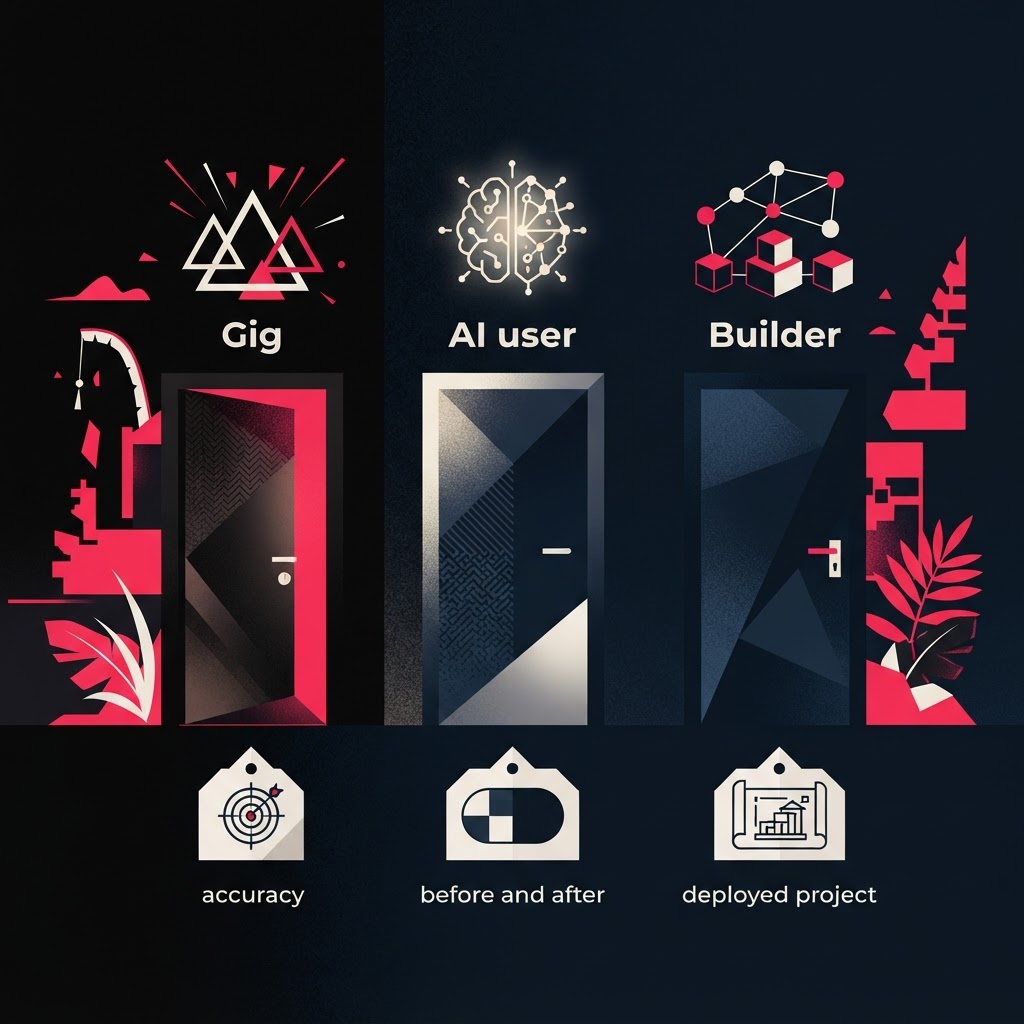
Entry level AI jobs with no experience: which roles really hire beginners, what each one tests, what it leads to, and the proof that gets you in.
Want to build this way instead of reading about it? Email academy@exventure.co.
Online · Las Palmas · Bali
Three days with the operators building what replaces the old map: academy alumni, portfolio founders and the people who fund them, in one room.
EX Venture Group and its affiliated service companies are incorporated and operate in the United States and Europe only. They do not operate in Indonesia and do not provide services into or from Indonesia. All Bali-based operations, including EX Epic Academy, are solely managed and operated by EPIC Solutions PT.
▸ UU PDP No. 27/2022 · UU ITE · Cookie consent required
We use essential cookies to operate this site and analytics cookies to improve it. In line with Indonesia’s UU PDP (Personal Data Protection Law, UU No. 27 of 2022), your consent is required for non-essential cookies. See our Privacy Policy.