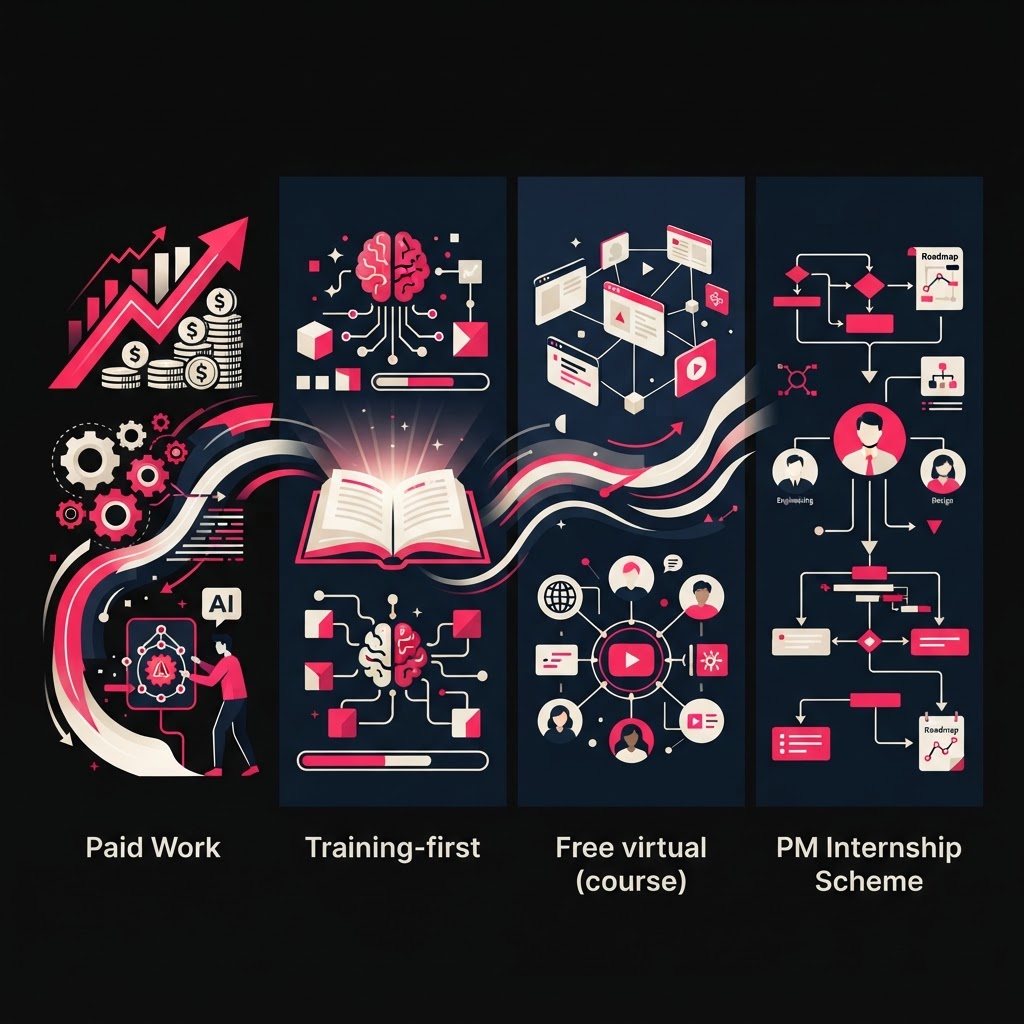
Search "AI internship for freshers" and you get a wall of listings. Paid ones, unpaid ones, ones that start with a month of training, ones that are really an online course with a certificate at the end. They all use the same word. That is the problem. A fresher who sends 40 applications into the wrong kind of internship loses a month and learns nothing.
We run an AI internship program, so we read this market from the other side of the table. This guide is the map we wish every applicant had: the four things called an AI internship right now, how to read a listing in 60 seconds, what fresher roles actually ask for, and how to get picked when a thousand other people clicked Apply.
The short answer
Fresher AI internships are real and many are paid. But pick the kind of internship first, then the listing, then send one targeted application backed by one project that matches it. Volume does not win this. Fit does.
The four things called an AI internship for freshers
Paid work internships
This is what most people picture: a company pays you a stipend to do real work on its product. One Bangalore AI company posts a role that is explicitly for freshers only, needs no experience, pays a monthly stipend and runs 3 to 6 months from the office or from home. Another, a fresher AI product engineer role on Internshala, runs 6 months at 8,000 to 12,000 rupees a month, with a job offer of up to 2.1 LPA if you convert, and had more than 1,000 applicants three weeks after posting.
Best for: freshers who can already build a little and want a paid seat with a path to a job.
Training-first internships
A growing category puts training before the work. One listing spells it out: one month of mandatory training, then two months of live project work, for freshers with basic Python and AI/ML knowledge. Another goes further and requires no prior AI or programming experience at all, then filters candidates through a masterclass, a training program, a 90 minute aptitude assessment and an in-person round, paying 23,500 rupees a month to those who make it.
Best for: freshers starting from zero who are willing to be evaluated on learning speed instead of a CV.
Free virtual internships (which are courses)
Some of the most visible "internships" are training programs with a certificate. The honest ones say so. One UK provider describes its ten free online AI internships as training, not employment, with no stipend and no work for a company promised. Another free, self-paced program reports more than 45,000 interns and states plainly that it does not promise a job.
Nothing wrong with that. A free structured course can be a good first step. Just do not count it as work experience in your head, because the person reading your CV will not.
The government route: PM Internship Scheme
If you are in India, there is a route most AI listicles skip. In April 2026 the government opened the PM Internship Scheme to final-year undergraduate and postgraduate students aged 18 to 25, with a No Objection Certificate from their institute, paying at least 9,000 rupees a month across more than 300 participating companies. The guidelines set internships of 6 or 9 months with at least half the time in an actual work environment, and exclude graduates of IITs, IIMs, IIITs, IISERs, NIDs, national law universities and IISc.
The scheme is not AI-specific. You have to filter for roles that touch data, automation or AI tools yourself. But for an eligible fresher, it is a structured, paid seat at a large company.
How to read a fresher AI internship listing in 60 seconds
The five lines that matter
| Line in the listing | What to look for | What it tells you |
|---|---|---|
| Stipend | A number, not "performance based" only | Whether they value the work |
| Duration | 3 to 6 months | Under 2 months rarely gets past setup |
| Day-to-day tasks | Verbs: build, test, ship, integrate | "Attend sessions" and "explore" mean training |
| Conversion line | "Job offer post internship" with a figure | Whether there is a next step |
| Applicant count | Under a few hundred, or posted this week | Your odds and your urgency |
For calibration, Internshala's own snapshot says AI internship stipends typically range from 1,000 to 75,000 rupees a month. That spread is the four categories above mixed into one feed. The listing lines are how you pull them apart.
Red flags
- A fee to apply or to "confirm your seat". The same platform states that applying for an internship there is free. If someone charges you, you are buying a course. Decide whether you want that course, and call it what it is.
- Every task is learning. If the day-to-day list is all "attend live sessions" and "complete modules", there is no employer work in it.
- Certificate as the only perk. A certificate is a receipt, not proof. We wrote up what an AI internship certificate is actually worth separately.
- No named product. Real internships tell you what you will work on. Vague ones tell you about "cutting-edge AI".
A note in fairness: our own program is unpaid. We think unpaid is defensible only with real responsibility, a live venture and a named path to a paid role, and we say so up front. Hold us to the same five lines.
What fresher AI listings actually ask for
Read across fresher listings and the bar is lower and more specific than you fear. One remote AI engineering internship asks that you have called an LLM API from code and can explain what a prompt does, and says university and personal projects both count. The product engineer role above wants at least one college, personal or academic project. An AI/ML work from home listing on the same platform accepts candidates from any academic background, with basic Python or ML preferred but not mandatory.
The pattern: basic Python, one model call you wrote yourself, one finished project. Not a degree in AI. Not five certificates. If you are missing the skills, start with our list of AI skills for freshers. If you are missing the project, our guide on how to get an AI internship with no experience walks through building the one that counts.
How to get picked when 1,000 others applied
That AI/ML work from home listing had 960 applicants six days after it went up. That is the real competition for a fresher seat, and it changes the strategy.
Apply in the first week, not the last
Popular listings fill their shortlist early. A listing posted three weeks ago with four figures of applicants is a lottery ticket. Sort by newest, check daily, and apply to the ones posted in the last few days.
Match one project to one listing
Read the day-to-day tasks and mirror them. If the listing says "build backend APIs and integrate AI services", lead with the project where you did exactly that, with the live link in the first line. One relevant project beats a long skills list every time we read applications.
Send a note to a human
After you apply, find the person who owns the work (founder, team lead, the name on the post) and send four sentences: what you built, the link, why this company, what you would do in week one. Our guide to cold email for a startup internship has the format and examples that got replies.
The fifth option: an immersive program
There is one more lane, and it is the one we run. EX EPIC Academy places freshers inside live ventures for four to six months, on site in Bali, across AI and automation, consulting, engineering, sales, research and content, unpaid with potential for a full-time transition. Interns take operational roles, with placements at Zero X in waste to energy, Gemino AI in automation and LIV Urban Sanctuary in wellness. The founder describes students from 26 nations working on 15 live projects, with no grades and no exams, and the parent group reports more than 250 operators trained and deployed through the Academy.
Who it suits: freshers who want months of shipped work a stranger can inspect, plus an international network, and who can cover living costs for that period. Who it does not suit: anyone who needs a stipend now. If that is you, go for PMIS or a paid listing first, and read our honest take on whether a startup unpaid internship is worth it before choosing. If going abroad is the draw, start with our guide to an AI internship abroad.
Whichever lane you pick, the test is the same one we apply on Fridays at the Academy: what did you ship this week? An internship that lets you answer that is a good one.
FAQ
Are AI internships for freshers paid?
Many are. Paid work internships and training-first programs often pay a monthly stipend, and the PM Internship Scheme pays at least 9,000 rupees a month. Free virtual internships pay nothing, because they are courses rather than jobs.
Can a non-CS fresher get an AI internship?
Yes. Some listings accept any academic background with Python preferred rather than required, and some training-first programs take people with no programming at all. Your strongest move is one small project that shows you can use AI tools on a real task.
Should I pay a fee for an AI internship?
No. Applying for a genuine internship is free. If a provider asks for money, you are paying for training. That can still be worth it, but compare it with other courses, not with internships.
Can IIT or IIIT graduates apply to the PM Internship Scheme?
No. The scheme guidelines exclude graduates of IITs, IIMs, IIITs, IISERs, NIDs, national law universities and IISc. Those freshers should target company internships and startups directly.