Most agentic AI roadmaps for beginners are written by people who already code, for people who already code. They open with four weeks of Python, march through frameworks, vector databases and multi-agent orchestration, and promise you a portfolio somewhere around month seven. If you have no CS degree, you quit in week three. Not because you are slow. Because nothing you built yet does anything for anyone.
This roadmap is ordered differently. You pick one real task on day one and spend 12 weeks making an agent that does it. Workflow before agent. No-code before code. Testing before frameworks. A real user at the end.
The short answer
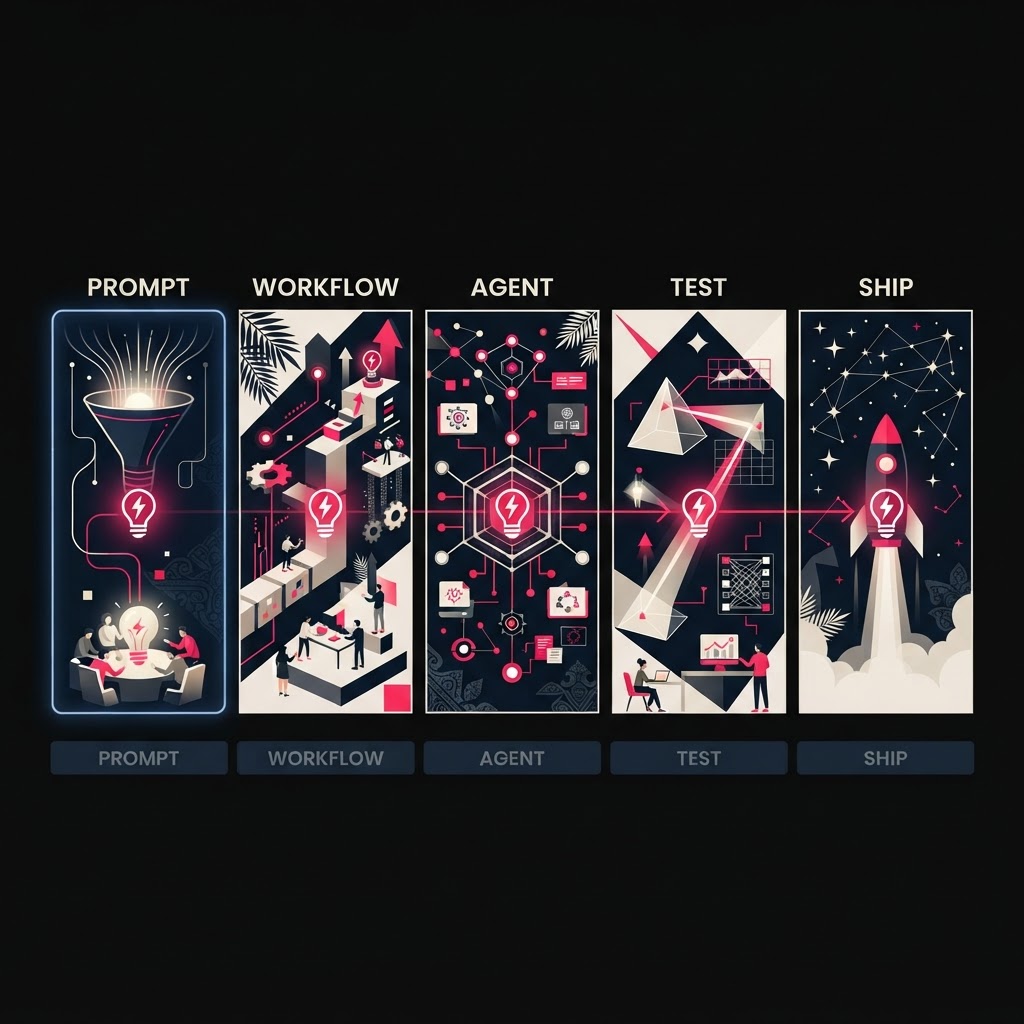
Twelve weeks at roughly eight to ten hours a week, in five blocks:
- Weeks 1 to 2: learn to prompt and learn where models fail.
- Weeks 3 to 5: automate your task as a fixed workflow, no code.
- Weeks 6 to 8: let the model choose the steps. Now it is an agent.
- Weeks 9 to 10: test it on a fixed set of cases until it breaks.
- Weeks 11 to 12: put it in front of a real person and ship it.
Everything else (multi-agent systems, custom protocol servers, deployment pipelines) is month four onwards. Not month one.
Why most agentic AI roadmaps lose beginners
Look at what currently ranks. One popular roadmap lays out eight stages, roughly 340 hours, about 7 to 8 months at 10 hours a week, and tells newcomers to add four to six weeks of Python before stage one. Another runs 10 stages over about six months, the first four weeks of which are Python and APIs.
Those plans are not wrong. They are the right plan for a developer moving into agents. For a beginner, they have two problems.
First, they are syllabi, not paths. You finish each stage with a mini-project that exists only to prove you finished the stage. Second, the payoff comes last. Seven months of preparation before anyone uses what you made is a long time to stay motivated on faith.
One roadmap author put the fix better than we can: watching a course feels like progress, but you only find out what you don't understand when you try to build something. So build from week one. And build the same thing all the way through.
Pick one task before you pick a tool
The single most important decision in this roadmap happens before you touch any software. Choose a task that is:
- Real. Someone does it today, by hand, at least weekly. You, a club, a family business, a friend's startup.
- Text-shaped. Reading emails, summarising documents, sorting requests, drafting replies, pulling data from pages into a sheet.
- Checkable. You can tell a right result from a wrong one in under a minute.
- Low blast radius. If it fails, someone is mildly annoyed, not out of money.
Good first tasks: triaging a shared inbox into categories and drafting replies; turning job listings into a ranked shortlist; summarising meeting notes into action items for a small team.
Bad first tasks: anything that moves money, sends messages without review, or needs a decision you could not explain yourself.
Then hold onto one idea from the people who build these systems for a living. Anthropic separates agentic systems into two kinds: workflows, where models and tools follow predefined code paths, and agents, where the model directs its own process and tool use. Their advice is to find the simplest solution possible and add complexity only when needed, which can mean not building an agent at all. A beginner who learns that early saves months.
The 12-week roadmap
Weeks 1 to 2: Prompting and the model's limits
Do your task by hand with a chat assistant. Twenty times. Write down every failure: the invented detail, the ignored instruction, the reply that was right once and wrong the next time.
What you learn here: how to write instructions with examples, how to ask for structured output (a fixed list of fields, every time), and what a context window means in practice when you paste in a long document.
Done when: you have one prompt that handles your task correctly on most of your 20 examples, and a written list of the cases where it does not.
Weeks 3 to 5: Automate it as a workflow, no code
Now take the human out of the copy and paste. Use a visual automation tool to run your prompt on a trigger: a new email, a new row, a new file. This is a workflow in the Anthropic sense. You decide the steps; the model fills in one of them.
Our one-day no-code agent plan walks through a first build on a visual canvas. If you are worried you are cheating by not coding, read our take on learning AI without coding. You are not. You are learning the part most coders skip: what the task actually needs.
Done when: your workflow runs by itself on real inputs for a week and you have logged what it got wrong.
Weeks 6 to 8: Turn the workflow into an agent
Here is the step every roadmap calls the turning point. A workflow follows your steps. An agent gets tools and chooses which to use. As one guide puts it, tool calling is the stage where a chatbot becomes an agent: you describe a function to the model, the model asks for it with arguments, your system runs it and hands back the result, and the model decides what to do next.
Give your agent two or three tools at most. For the inbox example: look up an order, check a calendar, save a draft. Then let it decide.
Watch what changes. It will sometimes take a smarter route than your workflow. It will sometimes loop, call the same tool repeatedly, or confidently do the wrong thing. That is the trade you are learning to judge.
This is also where you meet code for the first time if you want to. Once your no-code version works, build the same agent from zero in plain Python. It is one loop and a stop condition. Anthropic suggests starting with model APIs directly rather than frameworks, because frameworks add abstraction that hides the prompts and responses you need to see when debugging.
Done when: your agent completes the task on real inputs and you can explain, for any run, why it picked each tool.
Weeks 9 to 10: Test it until it breaks
The stage beginners skip is the one that makes the work credible. One roadmap calls evaluation the stage most learners skip and most employers care about, and recommends a fixed set of 20 to 50 realistic tasks with expected outcomes, re-run after every change.
You already have the raw material: your logged failures from weeks 1 to 8. Turn them into a test sheet. For each case, record whether the agent succeeded, how many steps it took, and whether a human would have accepted the result. Then try to break it on purpose: a malicious email that tells it to ignore instructions, a document twice as long as usual, an input in another language.
Done when: you can say a number. "It gets 41 of 50 cases right; here are the nine it misses and why." That sentence is worth more in an interview than any certificate.
Weeks 11 to 12: Ship it to a real user
Hand it to the person who used to do the task by hand. Keep a human approval step on anything it sends. Watch them use it for two weeks. Fix what annoys them.
Then write it up: the task, the before and after, your test numbers, the failures you could not fix and why you stopped there. One page. That write-up and a short screen recording are your portfolio piece.
Done when: someone other than you uses it without you in the room.
Where code becomes unavoidable
Honesty matters here. You can get through weeks 1 to 8 without writing code, and you will understand agents better than many people who started with a framework. But no-code tools hit a ceiling. Custom tools, fine control over the loop, proper test harnesses and anything you want to run cheaply at volume will push you into code, almost always Python.
That is why the developer roadmaps front-load it. The difference is timing. Learning Python in week 9, because your agent needs a tool your visual builder cannot offer, is a very different experience from learning it in week 1 for a reason you cannot see yet.
When you are ready for structured lessons, Microsoft's free AI Agents for Beginners course is a solid companion from week 6. Know before you start that its code samples use Microsoft Foundry and need an Azure account.
What to skip as a beginner
You will see these on every roadmap. Leave them for later:
- Multi-agent systems. Get one agent reliable first. Two unreliable agents talking to each other is not progress.
- Building your own protocol servers. Use existing tool connectors until you hit a real limit.
- Framework hopping. Pick one tool per stage. Switching frameworks every week teaches you nothing that transfers.
- Deployment infrastructure. Containers and orchestration matter when strangers depend on your agent. Not before.
When you do want a structured, intensive version of all this, our breakdown of what an agentic AI bootcamp should give you covers how to tell a good one from a slide deck. And if your goal is broader than agents, start with our general AI learning roadmap instead.
Proof beats certificates
Here is why we order the roadmap around one real task. At EX EPIC Academy we skip the case studies. Participants from 26 nations work on 15 live projects, and interns take operational roles inside real ventures, including AI automation work at Gemino AI. The pattern we see is consistent: people learn agents fastest when the agent has a job and a user who will complain if it breaks.
You do not need to be in Bali to follow this roadmap. You need one task and twelve honest weeks. If you want to do it inside live ventures with a team around you, the Academy runs 4 to 6 months on-site in Bali, unpaid, with a potential full-time transition. We state the unpaid part plainly because you should weigh it.
You ship or you don't. Start with the task.
FAQ
Can I learn agentic AI without coding?
Partly. You can get through prompting, a no-code workflow and a working no-code agent with tools, which is weeks 1 to 8 of this roadmap. Custom tools, rigorous testing and low-cost operation at volume eventually need code, usually Python. Learn it when your project demands it.
What is the difference between an AI workflow and an AI agent?
A workflow runs the model and tools along steps you defined in advance. An agent lets the model decide its own steps and which tools to call. Anthropic recommends using the simpler workflow wherever it is enough, because agentic systems trade latency and cost for better task performance.
How many hours a week does this roadmap need?
Plan on eight to ten. Most of that time is building and logging failures, not watching lessons. If you have less time, stretch each block rather than skipping the testing weeks.
How do I know my agent is good enough to show an employer?
When you can quote a success rate on a fixed set of realistic test cases, explain the failures, and point to a real person who uses it. A test set of 20 to 50 cases is a sensible size for a first project.